
Speed Bumps in Sweden: A Guide to Rules, Types and Safety
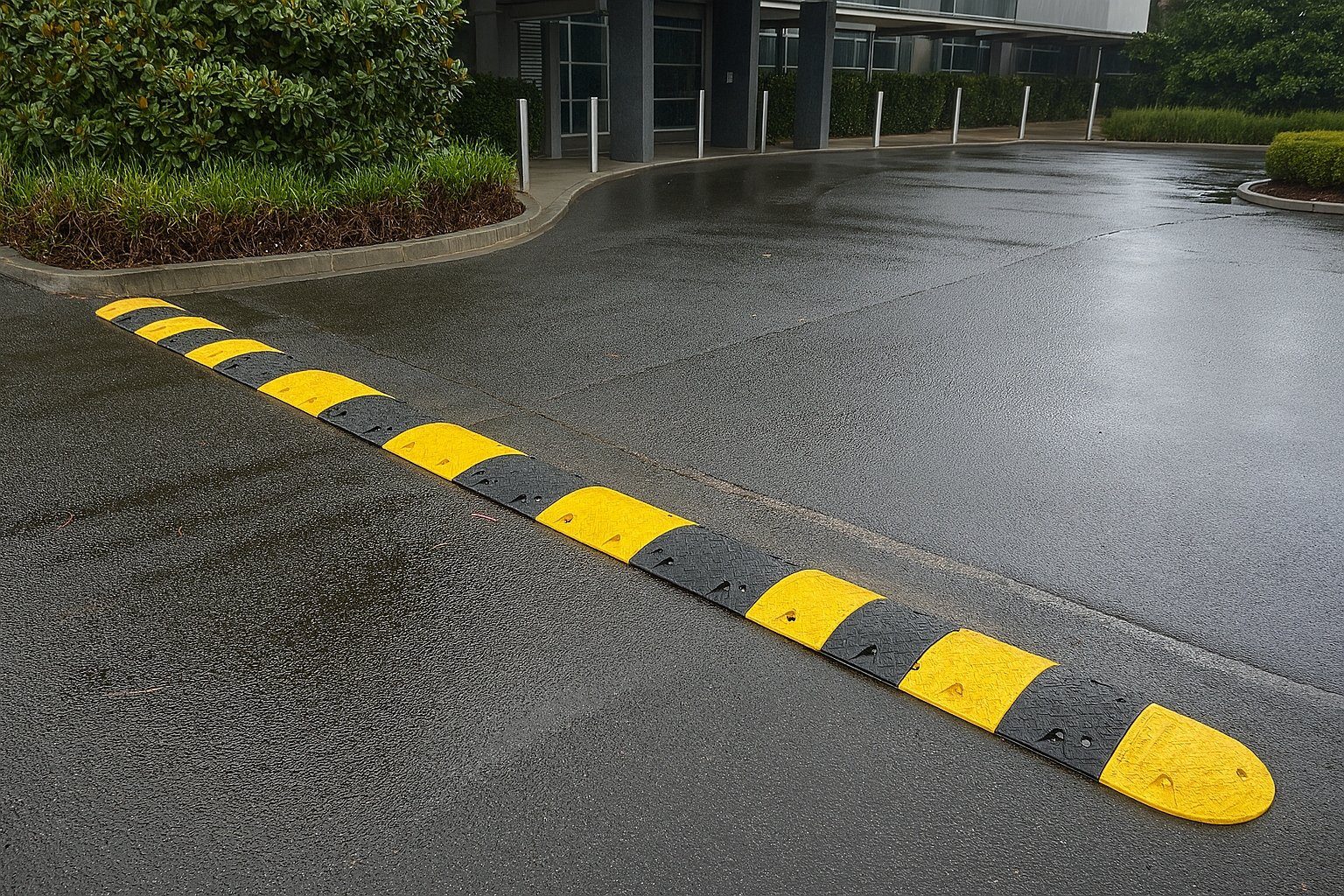
A speed bump is a physical device on a road that forces drivers to slow down. It is an active tool for creating a safer traffic environment, especially for vulnerable road users such as children and pedestrians, in areas where regular speed limit signs are simply ignored.
A speed bump is the most direct measure when signs and reminders aren’t enough to bring speeds down. Studies show that between 33 and 80% of Swedish drivers speed, and a well-placed speed bump lowers actual speeds by 5–20 km/h – often the difference between a near miss and a serious accident. In this guide, we walk you through how to choose the right type of speed bump, which rules apply, where it should be placed and how to install it so it lasts for many years.
Quick guide: the right speed bump for your environment
- Parking lot, industrial yard or low-speed area: Modular rubber speed bumps such as Speed Bump SLOWLY handle up to 20 tons and can be adapted to the width of the roadway.
- Trucks, forklifts and heavy traffic: Choose a speed bump for heavy traffic or the wider SafeRide model – both with a weight capacity of 40 tons.
- Garages, loading docks and walking-speed areas: A lower bump such as EasyRide reduces speeds to 1–10 km/h without damaging vehicles.
- Events, construction sites and temporary needs: A portable option such as the collapsible Snoken speed bump can be laid out and removed in minutes. You’ll find more models among our portable and temporary speed bumps.
- Residential area, housing cooperative or homeowners’ association: A softer, more attractive solution is planters as speed bumps, which both reduce speeds and beautify the street.
Different types of speed bumps – and when they fit
Different traffic environments call for different solutions. The wrong choice can cause noise and vibrations in nearby homes, or needlessly obstruct buses and emergency vehicles. The most common types are:
- Circular humps and road bumps: The classic, rounded shape that effectively slows down passenger cars. Suitable for residential areas and parking lots, but less suitable on streets with bus routes since the crossing is abrupt.
- Speed tables and speed cushions: Longer, flatter obstacles with a gentler profile, more forgiving for buses and ambulances. Often combined with pedestrian crossings. For permanent installations, there is a concrete speed cushion with cast-in contrast marking.
- Bus cushions: Narrower humps that passenger cars are forced to drive over, while the bus’s wider wheelbase passes on either side. They reduce car speeds without disrupting public transportation.
- Planters and chicanes: Create a lateral shift in the roadway instead of a vertical obstacle. They break up long straight stretches and force drivers to actively slow down.
A lower version of a hump is often called a road hump – read more about the differences in our guide to road humps.
Choosing a material: rubber, concrete or asphalt?
Traditional obstacles made of asphalt and concrete are durable but require groundwork and can crack from frost heave. Speed bumps made of recycled rubber have therefore become the first choice in most environments: they are modular, absorb impacts, dampen noise and vibrations, and are bolted directly into asphalt or concrete without altering the road surface. They are also easy to relocate if your needs change. See the full range of fixed speed bumps.
Speed bump rules – who is allowed to install them?
The first thing you need to figure out is who the road authority is, meaning the party legally responsible for the road:
- The municipality – responsible for most streets in urban areas.
- The Swedish Transport Administration (Trafikverket) – responsible for state roads.
- A private road authority – usually a road association or joint property association that maintains private roads, for example in residential areas.
Only the road authority may decide on and install speed bumps on the road. Placing an obstacle on your own initiative on a road you are not responsible for is prohibited and punishable by law – and you can be held personally liable if the obstacle causes an accident.
Speed bumps on private roads and in joint property associations
On a private road, the road authority decides for itself, but the decision normally needs to be made formally – for a joint property association or road association, this means a resolution at the association meeting. If the road receives a state maintenance subsidy, there may be accessibility requirements to take into account. On entirely private land, such as an industrial yard, a parking garage or a housing cooperative’s own property, the property owner decides and no permit is required.
Signage and visibility are a must
A speed bump must never come as a surprise. On public roads, road sign A9 – Warning for speed bump must be put up well ahead of the bump, and the bump must be clearly visible even in the dark thanks to reflectors and contrasting colors. We’ve gathered everything about the sign in our guide warning for speed bump, and you’ll find the signs among our road signs and traffic signs.
Placement: how to get maximum effect
A speed bump’s value is determined by where it is located. Start with a simple survey:
- Where are speeds highest? Long straight stretches encourage high speeds – a bump early on the stretch sets the tone.
- Where are the risks greatest? Pedestrian crossings, bus stops, playgrounds and driveways where vulnerable road users are present.
- What is the visibility like? Never place a bump right after a blind curve or the crest of a hill – drivers must have time to spot it and slow down safely.
A common mistake is installing just a single bump. This leads to “kangaroo driving,” where drivers brake hard before it and accelerate right after – more noise and almost no effect on average speed. Instead, work with a series of bumps spaced 50–80 meters apart, so speeds never have time to build up in between.
There is clear evidence that this works: Gothenburg’s systematic rollout of speed bumps has lowered average speeds in 30 km/h zones by 10–15 km/h and reduced accidents by 40–60% on treated stretches, according to M Sverige’s review of the regulations.
Also consider the surroundings: avoid placing bumps right outside bedroom windows, check with the fire and rescue services if the stretch is an emergency route, and make sure snowplows can get through. If you want to measure the problem before you take action, a speed display sign or traffic counter can show you in black and white where and when people are speeding.
Mounting: get it right from the start
A carelessly mounted speed bump quickly loses its function and can create new hazards. Here’s how to do it:
- Prepare the surface. The surface must be clean, dry and level – uneven or cracked asphalt must be repaired first. The bump must lie completely flat.
- Position and mark. Lay out the modules exactly according to plan and mark the drill holes so the load is distributed evenly.
- Drill and fasten. Use a drill bit suited for asphalt or concrete, clean out the holes and fasten with the hardware included with the product.
- Ensure visibility. Add reflectors, end caps and signage so the bump is noticed in time, all year round.
Keep in mind that rubber speed bumps require a paved surface – on gravel roads, planters, concrete blocks or other freestanding obstacles work instead. Inspect the installation regularly: check that the bump lies flat, that the fasteners are secure and that any damage from snowplowing is repaired right away.
Frequently asked questions about speed bumps
Can I install a speed bump myself?
Not on public roads – there, only the road authority (the municipality or Trafikverket) may install obstacles. On private roads, a decision by the road authority is required, which for a joint property association is normally made at the association meeting. On your own private land, such as an industrial yard or parking lot, you decide for yourself.
How much does a speed bump cost?
Modular rubber speed bumps start at a couple of hundred kronor per module, and a complete installation for a standard roadway usually costs a few thousand kronor including end caps. Heavier solutions in concrete or granite cost considerably more. You can see current prices directly in our range of speed bumps, and for larger projects you can request a quote.
Which speed bump works with bus traffic?
Avoid classic rounded humps on bus routes. Instead, choose bus cushions, which the bus’s wide wheelbase straddles without driving over them, or longer speed tables with a gentle slope. Both reduce speeds for passenger cars without disrupting schedules or passenger comfort.
How do speed bumps affect emergency vehicles?
A poorly designed obstacle can delay ambulances and fire and rescue services. If the bump is to be placed on a potential emergency route, always check with the fire and rescue services first. They often prefer speed tables or bus cushions, which minimize delays.
What is the difference between a speed bump, a road hump and a speed hump?
Speed bump is the umbrella term for all physical speed-reducing measures. Speed humps are the classic raised sections of the roadway, while a road hump usually refers to a lower, smaller version – read more in our guide to road humps.
The right speed bump, placed in the right spot and mounted correctly, makes a difference from day one. Explore the full range of speed bumps at Nordguard – and if you’re unsure what suits your stretch of road, our experts are happy to help. Contact us or request a quote for your project.
Ready to take the next step?
We help you develop solutions tailored to your needs. At Nordguard, we strive to make the ordering process as smooth as possible. By offering support and guidance throughout the entire purchasing experience, we make sure you feel confident and satisfied with your choice of protection products.+46 10 153 90 50
[email protected]