
Everything About Loading Dock Impact Protection: Your Complete Guide
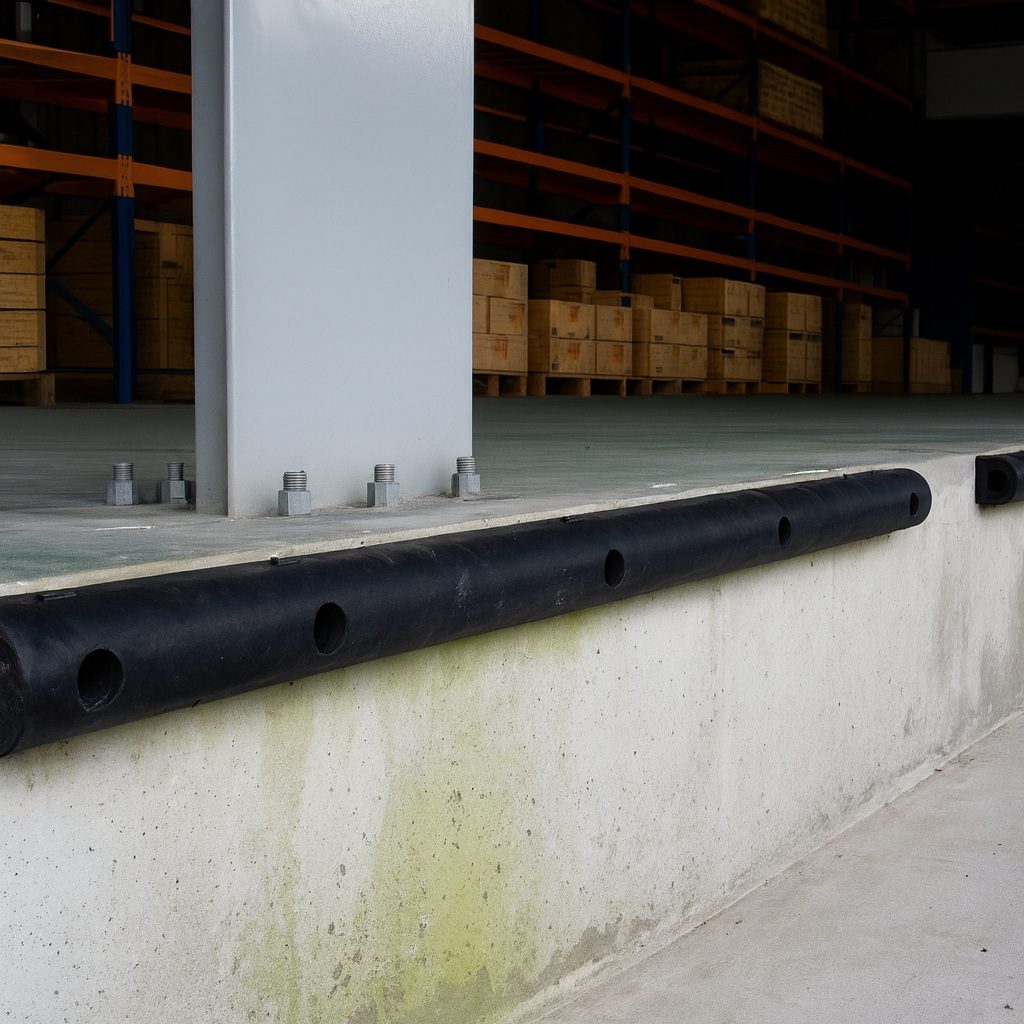
Impact protection at a loading dock is far more than just a piece of steel or rubber. Think of it as the loading dock’s own bodyguard: a robust barrier designed to take the hit from reversing trucks and forklifts. Its job is to protect both your property and the vehicles from costly damage and, most importantly, to make sure no one on your staff gets hurt.
Why loading dock impact protection is a no-brainer investment
Seeing impact protection as a pure expense is short-term thinking. In reality, it is one of the smartest investments you can make in safety, efficiency and long-term profitability. An unprotected loading dock is a ticking time bomb of hidden risks that can quickly turn a small mistake into a major financial blow.
Picture a completely ordinary scenario: a driver under time pressure misjudges the distance and backs into the dock edge a little too fast. Without protection that absorbs and dampens the force, the consequences can be serious:
- Structural damage: Cracks in the concrete, broken doors and, in the worst case, damage to the entire facade.
- Vehicle repairs: Dents and scratches are just the beginning. Damaged bumpers and broken taillights on both trucks and trailers add up fast.
- Downtime: A damaged loading dock may have to be closed for repairs. That immediately creates bottlenecks, delays and disruptions across your entire logistics flow.
- Personal injury: This is the most serious risk. Staff getting pinned between a heavy vehicle and the dock can suffer life-threatening injuries and long periods of sick leave.
Proactive safety always costs less in the long run
The philosophy is simple: prevention is always more cost-effective than repair. The hidden costs of a single accident – repairs, lost working hours, administration and potential fines – quickly spiral and far exceed the investment in truly good impact protection. And if you choose CE-marked products, such as our dock bumpers and rubber bumpers, you get the added assurance that the protection meets the EU’s strict safety requirements. Read more about how impact protection is a crucial investment in workplace safety.
In fact, the regulations of the Swedish Work Environment Authority (AFS 2023:11) set clear requirements that loading docks must be designed to minimize risks. Purpose-built dock protection is a direct answer to those requirements. In practice, we see that companies that install protection reduce their dock repair costs by up to 50 percent annually. For a larger facility, that means hundreds of thousands of kronor saved.
Understanding these risks and costs is the first step toward building a safer, smoother and more profitable logistics environment.
Not sure how best to protect your loading dock? Our experts can help you analyze your unique needs and develop the optimal solution. Get in touch for free advice and a tailored quote.
How to choose the right material and design
Choosing the material and design for loading dock impact protection is absolutely critical. It is not just about bolting up a barrier, but about installing protection that can actually handle the stresses at your specific facility. Think of the protection as a shock absorber on a car: its most important job is to capture and distribute the energy from an impact to protect both the vehicle and, in this case, the dock structure.
Well-built impact protection acts as a first line of defense against the enormous forces generated when a truck or forklift docks. Without that cushioning, all the energy would go straight into the building, which quickly leads to cracks in the concrete, damage to the door and other repairs nobody wants to pay for.
Comparing common materials
The material is the very heart of how the protection works. The most common options each have their own strengths and weaknesses that make them suitable for different situations.
- Rubber (SBR/EPDM): This is the absolute classic, and for good reason. Rubber has an outstanding ability to absorb impacts and is incredibly durable. When struck, it compresses and then springs back to its original shape, effectively neutralizing the force. Perfect for high-traffic facilities.
- Steel: When it comes to sheer strength against direct hits and shearing forces, steel is unbeatable. It is often used as a surface-mounted wear plate on a rubber bumper. This combination protects the rubber from being worn down by the vertical movements of trucks with air suspension.
- Polyethylene (HDPE): High-density polyethylene is a modern alternative that combines toughness with low friction. Its smooth surface reduces wear on both the protection and the vehicle. It is also extremely resistant to chemicals and the elements.
To really get it right, you need to understand the differences. Dive deeper into our guide on choosing materials for impact protection and when to choose plastic, steel or a combination.
The hidden importance of design
A good material is only half the job – the design is at least as important. Details such as internal reinforcements, for example steel plates molded into a rubber bumper, are absolutely critical to durability. These plates distribute the force from the anchor bolts and ensure the protection does not deform permanently or simply tear loose after repeated impacts.
Impact protection without the right internal reinforcement is like a tire without air. It may look right, but it collapses completely under real pressure. It is the small details in the design that guarantee it works over the long term.
In the logistics industry, collisions from forklifts and trucks cause millions of kronor in damage every year. According to industry reports, as much as 40 percent of all loading dock damage is caused by accidental reversing impacts. Properly designed rubber bumpers cushion the impact, and robust steel mounting plates minimize the risk of the protection being torn off.
Shape matters too. A D-shaped profile provides a wider contact surface, while a thicker, rectangular bumper can absorb more energy. The choice must always be based on your unique conditions – everything from the types of vehicles you have and how heavy the traffic is to the local climate.
Not sure which material or design is best for your operation? Contact our experts today and we will help you analyze your needs and find the perfect solution.
Understanding CE marking and safety standards
When you choose impact protection for your loading dock, it is easy to get caught up in discussions about materials and dimensions. But there is one detail that outweighs everything else when it comes to safety and function: CE marking. Many people see it as just a small logo, but in reality it is your most important seal of quality.
CE marking is the manufacturer’s promise. It is a declaration that the product meets the EU’s strict health, environmental and safety requirements. For impact protection, it means the product has undergone rigorous testing and proven that it delivers what it promises. It is your guarantee that it will not give way when it matters most.
What does CE marking mean in practice?
For impact protection to carry the CE mark, it must meet a range of specific requirements. This is not about bureaucracy, but about concrete proof that the product is reliable and durable.
Among other things, the process requires the manufacturer to demonstrate:
- Proven material strength: The material – whether rubber, steel or polyethylene – must demonstrably withstand the specified load without cracking or deforming permanently.
- Verified collision tests: The product must have undergone controlled crash tests to confirm that its energy-absorbing capacity matches what the specification states.
- Proper documentation: Everything from technical drawings and material certificates to test reports must be available and in order.
Choosing impact protection without certification is like buying a car without crash test results. You simply do not know whether it will work when it counts, which creates a dangerous, false sense of security.
The link to Swedish workplace safety regulations
In addition to EU standards, as a property owner or warehouse manager you must comply with Swedish regulations. The regulations of the Swedish Work Environment Authority (AFS) are central here. Their purpose is to create safe workplaces and prevent accidents, and ignoring them can result in substantial penalty fees.
Forklift collisions are a common and costly problem that is estimated to affect 25 percent of all Swedish warehouses every year. It is not just about damage to pallet racking and docks, but about a direct risk to staff. Under the Swedish Work Environment Authority’s AFS 2023:11, workplaces must be designed to avoid crushing hazards – and correctly sized impact protection is a key component here.
By investing in CE-marked impact protection for your loading dock, you not only make sure you meet legal requirements. You also protect your staff, your property and your business from completely unnecessary risks. Want to understand the regulations in depth? See our overview of current regulations and standards for impact protection.
Knowing what to demand is essential. Make sure your suppliers can provide all the necessary documentation. It is your peace of mind and proof that you have made a durable and safe investment.
Ensure maximum effectiveness with the right installation
First-class impact protection loses all its function if it is incorrectly sized or carelessly mounted. It is like buying the safest lock on the market but attaching it with double-sided tape – a false sense of security that will not hold when it really counts. For your loading dock impact protection to truly do its job, the installation must be carried out with care and take every factor into account.
Correct sizing and mounting is not a minor detail, but the very heart of a working protection system. Without a stable foundation, even the most robust product can give way in a collision and cause exactly the damage you were trying to prevent. It all comes down to understanding the forces the protection will be exposed to and adapting the installation accordingly.
Sizing based on vehicles and angle of impact
It all starts with analyzing the traffic that moves around your loading dock every day. The three most important factors are vehicle type, weight and the most likely angle of impact in a collision. A fully loaded 40 tons truck reversing straight in generates a completely different force than a nimble 3 ton forklift that happens to swing into the dock edge from the side.
These variables directly determine the size, material and thickness of the protection. A heavy truck requires thicker, more energy-absorbing protection, while an area with heavy forklift traffic may need protection with a durable steel face to withstand wear and side impacts.
Installing impact protection without first analyzing the traffic is pure guesswork. It is like building a house without knowing whether the ground is bedrock or clay – the result is rarely good.
To be sure you choose right from the start, a thorough needs analysis is essential. Consider which vehicles use the dock most often and what the worst-case scenarios are.
A checklist for secure anchoring
Once the right protection has been chosen, the most critical step remains – anchoring. Impact protection is never stronger than its weakest link, and that link is almost always the bolts holding it in place. Choosing the right anchoring is just as important as choosing the right protection.
Here is a simple checklist to ensure robust mounting:
- Analyze the substrate: Is it solid concrete, asphalt or a steel structure? Each material requires its own specific type of anchoring. Expansion bolts are excellent in concrete, but completely wrong for asphalt.
- Choose the right bolts: The size and grade of the bolts must match the expected load. Heavy-duty applications require hardened steel bolts with the correct length and diameter.
- Use mounting plates: Mounting plates help distribute the force over a larger area and prevent the bolts from being pulled out of the substrate in a heavy impact. This is especially important in porous materials.
- Correct tightening torque: The bolts must be tightened to exactly the right torque. This ensures maximum strength without damaging either the substrate or the protection itself.
- Check the mounting height: A common mistake is mounting the protection too high or too low. It should be positioned to meet the most likely point of impact, which is usually level with the truck bed or the forklift’s bumper.
Following these steps is crucial for a safe and durable solution.
The diagram below shows the basic process for ensuring that a product such as impact protection meets the necessary safety requirements, from concept to testing and approval.
This visual guide shows the importance of a structured process in which every step, from material selection to final installation, is based on tested performance and safety. Just as a CE-marked product has undergone rigorous testing, the installation must follow proven methods to work as intended.
Incorrect installation can not only lead to costly property damage but also create serious safety risks. To be completely sure your protection is mounted correctly and delivers maximum effect, we recommend hiring experts.
Do you need help with a needs analysis or professional advice on installing loading dock impact protection? Contact our experts today, and we will help you create a safe and durable solution tailored to your operation.
The total cost of your impact protection
Focusing only on the price tag when choosing impact protection for a loading dock is one of the most common – and most expensive – mistakes you can make. The upfront cost is only a small part of the total cost of ownership, or TCO. To make a truly smart investment, you need to look beyond the purchase price and consider the product’s entire life cycle.
The real cost includes everything from installation and maintenance to inevitable repairs and expected service life. A cheap solution can quickly become an expensive headache when it constantly needs to be repaired or replaced. At the same time, a product that is more expensive upfront but more robust almost always turns out to be the most cost-effective choice over time.
Breaking down the total cost of ownership (TCO)
To understand the true cost, we need to look at all the components that together make up the total cost of ownership. When you add them up, you get a much fairer basis for comparison that helps you avoid unpleasant surprises down the road.
The most important items to include in the calculation are:
- Purchase price: The initial investment in the product itself.
- Installation: The cost of mounting, including labor and any special materials such as anchoring.
- Maintenance: Regular inspections, cleaning and possibly re-tightening bolts.
- Repairs & Spare Parts: What it costs to repair or replace parts damaged in a collision.
- Expected service life: How many years the product is actually expected to last before it must be replaced completely.
Analyzing these factors quickly makes it clear that a high-quality solution with minimal maintenance and a long service life usually wins in the long run.
Example calculation: Low cost vs. quality
Let’s make it concrete with a simple example calculation. Here we compare a cheaper, more basic impact protection with a robust quality solution from Nordguard over a ten-year period. The figures are estimates to illustrate the principle.
Seeing the total cost over time is often an eye-opener. The cheaper option upfront can quickly become a cost trap once hidden expenses for repairs and replacements start to appear.
10-year cost comparison between low cost and quality
| Cost item | Low-cost protection (example) | Quality protection (Nordguard) |
|---|---|---|
| Purchase price | 5,000 SEK | 12,000 SEK |
| Installation | 3,000 SEK | 3,000 SEK |
| Annual maintenance | 1,000 SEK/year (10,000 SEK) | 200 SEK/year (2,000 SEK) |
| Repairs (estimated) | 2 replacements (16,000 SEK) | 1 repair (2,500 SEK) |
| Service life | 3-5 years | 10+ years |
| Total cost (10 years) | 34,000 SEK | 19,500 SEK |
As the example shows, the protection that costs more upfront ends up over 40% cheaper over ten years. The reason is simple: the low-cost protection has to be replaced completely several times and requires more maintenance, which quickly eats up the small savings made at purchase.
The hidden value that doesn’t show up on the invoice
Beyond the direct costs, there are "soft" values that have an enormous impact on your bottom line. A robust and reliable solution delivers so much more than just physical protection.
Investing in quality is not an expense, it is an investment in continuity. Every hour a loading dock is closed for repairs is a direct loss in the form of delayed deliveries, dissatisfied customers and internal chaos.
High-quality impact protection leads to:
- Reduced downtime: Fewer repairs mean your logistics can keep running without interruption.
- Increased safety: A safer work environment reduces the risk of accidents and costly sick leave.
- Better morale: Staff who feel safe at work are both more productive and more engaged.
These factors have a direct financial value that far exceeds the price difference between cheap and durable protection. By looking at the big picture, you can make a decision that truly benefits your business, both today and tomorrow.
Are you ready to make a smart, long-term investment in the safety and efficiency of your loading dock? Contact our experts today. We will help you analyze your needs and develop the most cost-effective solution for your facility.
Frequently asked questions about loading dock impact protection
When choosing and installing impact protection, a few questions almost always come up. Here we have gathered the most common concerns and provide straight, clear answers to help you reach the right decision for your facility.
Can’t find what you are looking for? Don’t hesitate to contact us directly. We are here to help with personalized advice.
At what height should loading dock impact protection be mounted?
The short answer: it depends entirely on which trucks back up to your dock. A good rule of thumb is that the top edge of the protection should be level with the average height of the truck beds using the dock.
But to be sure the protection does its job, you need to take a quick look at your actual fleet. If the protection is mounted too low, the truck risks riding over it, and if it is too high, the bumper can strike underneath it. Both scenarios render the protection ineffective.
How long does rubber impact protection last?
Service life can vary enormously. Everything from material quality and traffic intensity to weather conditions plays a role. Impact protection made of high-quality EPDM rubber can easily last over 10 years, even in really tough Nordic conditions.
At the same time, there are cheaper versions, often made from recycled tire rubber. These have a significantly shorter service life and may need to be replaced after just a couple of years once they start to crack and dry out.
Do I need different protection for trucks and forklifts?
Yes, absolutely. In the vast majority of cases, a combination of different types of protection is the only way to achieve a fully safe loading dock. The reason is simple: trucks and forklifts have completely different impact points and movement patterns.
- For trucks: Large, heavy-duty rubber bumpers are the way to go. They are designed to absorb the heavy, direct force of a reversing rig.
- For forklifts: Forklifts often move parallel to the dock and have a lower impact height. Lower-mounted safety railings, wall protection or bollards are needed here to protect both the dock edges and the building itself.
Thinking in layers and combining types of protection delivers by far the best result.
Can I install impact protection myself?
Sure, it may look simple on paper, but we always recommend letting professionals handle the installation. The reason is that incorrect mounting can render the entire investment pointless and, in the worst case, create a false sense of security that leads to accidents.
Skimping on installation is like building a sturdy roof but fastening it with the wrong kind of screws. It looks fine until the storm hits. Correct anchoring is essential for the protection to handle the energy it is built for.
Our experts make sure the anchoring is correctly sized for your specific substrate and the expected load. It is your guarantee that the protection works as it should – today and for many years to come.
Do you need guidance finding the right protection or help with a professional installation? Contact Nordguard today. Our experts will help you create a safe and cost-effective solution tailored to your operation. Visit https://nordguard.eu to learn more.
Ready to take the next step?
We help you develop solutions tailored to your needs. At Nordguard, we strive to make the ordering process as smooth as possible. By offering support and guidance throughout the entire purchasing experience, we make sure you feel confident and satisfied with your choice of protection products.+46 10 153 90 50
[email protected]