
A Practical Guide to Rubber Impact Protection for Safer Environments
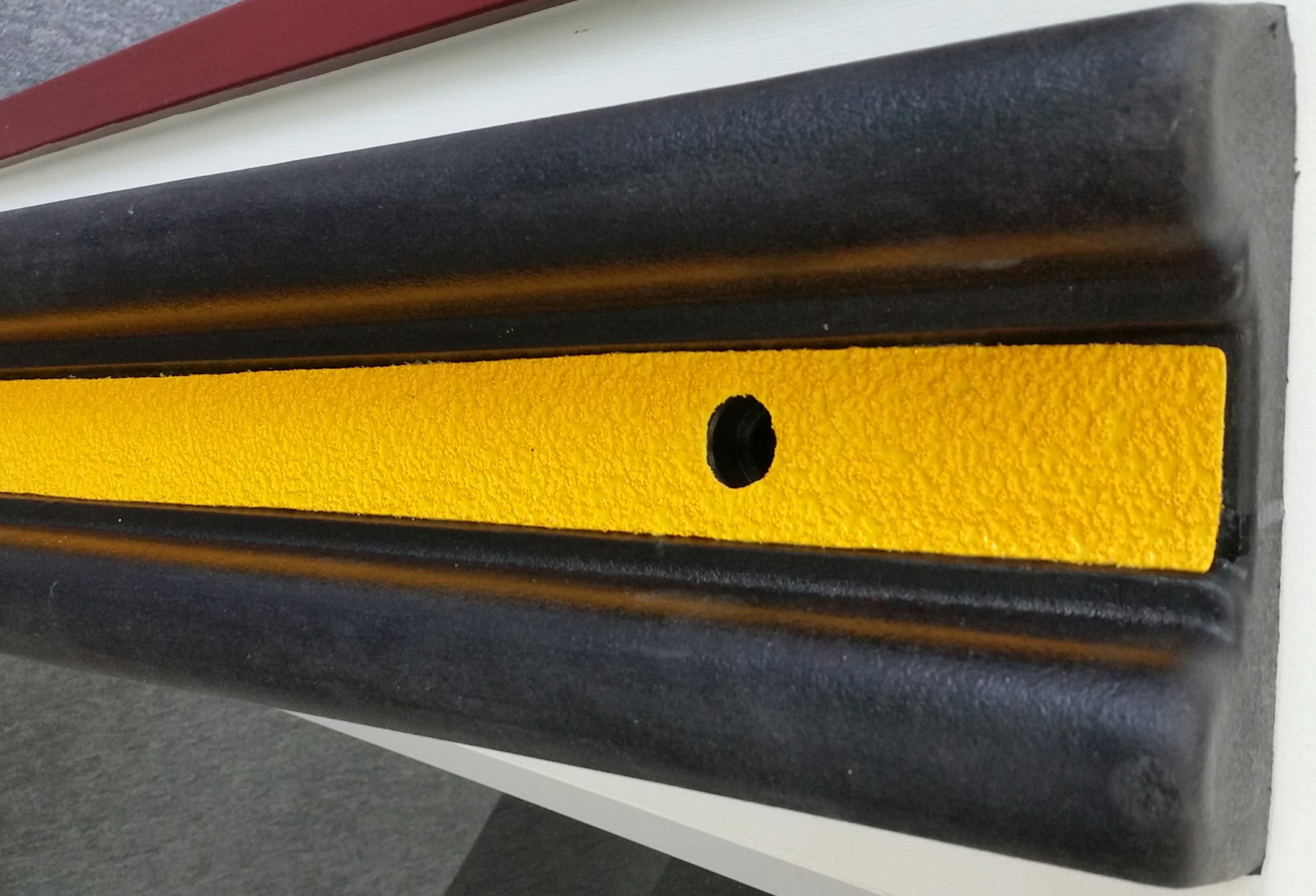
Rubber impact protection is a cost-effective and flexible solution for absorbing impacts and preventing damage to vehicles and buildings. It acts as a strategic shock absorber, ideal for environments such as parking garages and loading docks, where the risk of collisions is high. Our loading dock bumpers are an excellent example of how rubber protects against repeated collisions.
Why rubber impact protection is a smart investment
Think of rubber impact protection not as a simple piece of rubber, but as a built-in shock absorber for your property. Just like the suspension on a car, its job is to receive, absorb and distribute the force of an impact. By doing so, it minimizes damage to both the vehicle that hits it and the surface being protected.
This simple yet effective solution is often the difference between a minor incident and a truly expensive repair. It can prevent everything from unsightly scratches and cracked concrete on the walls of a parking garage to serious structural damage to load-bearing columns in a warehouse.
From reactive repairs to proactive protection
Many property owners and managers deal with damage reactively – an invoice only shows up after the accident has already happened. Rubber impact protection turns that whole approach around. It is a proactive investment in both safety and long-term finances that creates a protective layer, around the clock.
Instead of constantly budgeting for unexpected repairs, you install protection that works quietly in the background to protect vehicles, infrastructure and staff. It is about replacing recurring, time-consuming and expensive repairs with a predictable one-time cost that quickly pays for itself.
One of the biggest advantages of rubber in particular is its natural elasticity. Unlike rigid materials such as steel, which stop a vehicle abruptly and often damage both the car and the mounting, rubber gives way. It absorbs the energy and then returns to its original shape, ready to protect again.
Investing in the right protection from the start is one of the most effective ways to lower a property’s long-term maintenance costs. It reduces not only direct repair costs, but also the administrative burden and downtime that damage can cause.
Key features of rubber impact protection
To give you a quick overview of the main benefits of rubber-based impact protection, we have put together a table. It breaks down the most important features and the real-world benefits they deliver. If you want to learn more, read our guide on common damage prevented by impact protection.
| Function | Description | Primary benefit |
|---|---|---|
| Impact absorption | The elastic properties of rubber absorb and distribute collision energy. | Protects both vehicles and building structures from damage. |
| High wear resistance | The material withstands abrasion from repeated minor contact without cracking. | Long service life and minimal maintenance. |
| Weather resistance | Resists UV radiation, moisture and temperature fluctuations without deteriorating. | Suitable for both indoor and outdoor applications. |
| Flexible customization | Can easily be cut to size and mounted on flat surfaces, corners and columns. | Provides tailored protection for unique and exposed areas. |
Whether you need to protect a newly built loading dock or retrofit protection in an existing parking garage, rubber impact protection offers a reliable and financially smart solution.
Not sure which type of protection best suits your needs? Our team is happy to help you with a free needs assessment. Contact us at Nordguard for expert help and we will discuss how we can create a safer and more cost-effective environment for your business.
Choosing the right material: rubber, steel or plastic
The choice of material is absolutely crucial to how impact protection actually performs in the real world. Taking chances here can, at worst, lead to costly damage and a dangerous, false sense of security. Three materials dominate the market: rubber, steel and plastic. Each has its strengths and weaknesses, suited to very different environments and risks.
To choose correctly, you need to understand the fundamental difference in how they handle a collision. It is not just about stopping a vehicle, but about what happens to the building, the vehicle and the protection itself at the moment of impact.
Rubber – the flexible and forgiving choice
Rubber impact protection is designed to absorb and distribute energy. Think boxing glove rather than brick wall. When a vehicle hits the protection, the rubber deforms, absorbs the kinetic energy and then springs back to its original shape.
This property makes rubber superior in environments with frequent low-speed, low-force impacts.
- Parking garages: Here it effectively protects against carelessly opened car doors, bumpers and misjudged maneuvers – without scratching the paint or damaging the concrete wall. Our wall protection and corner guards are perfect for this purpose.
- Loading docks: Heavy-duty rubber profiles absorb impacts from reversing trucks, day in and day out, saving both the dock and the trailer from unnecessary wear.
- Narrow warehouse aisles: In forklift aisles, rubber reduces damage to both vehicles and racking when space gets a little too tight.
The biggest advantage is that rubber impact protection minimizes damage on both sides of the impact.
Steel – for an uncompromising stop
Steel is the exact opposite of rubber. Its main purpose is not to be forgiving, but to provide an immediate and uncompromising stop. Heavy-duty steel protection, such as a bollard or a railing, is built to protect critical infrastructure or people at all costs.
Steel is the right choice when the consequences of the protection giving way would be catastrophic. Think protecting a gas tank, a load-bearing column in a factory or a walkway next to heavy traffic. The downside is that the force the protection does not absorb is instead transferred to the vehicle and the mounting, which almost always results in extensive damage to the vehicle.
Plastic – a visible and lighter alternative
Plastic, usually in the form of polymers such as polyethylene, falls somewhere in between. The material is lighter than steel and often more flexible, giving it some ability to absorb energy. One of its biggest advantages is visibility; plastic protection is often made in bright safety colors such as yellow or orange, which act as a clear visual warning for drivers.
Durability, however, can vary significantly depending on the grade. Cheaper plastics can quickly become brittle from UV light and cold, while more advanced polymers offer excellent resistance. Plastic is often a good choice for marking off zones and protecting against lighter indoor forklift traffic. For an even clearer picture, we recommend our in-depth guide on choosing materials for impact protection.
The takeaway is simple: Proactively installing the right protection is a smart investment that prevents the unpredictable – and often high – costs of after-the-fact repairs.
Analyzing the life cycle cost – purchase, installation, maintenance and potential damage costs – is key. Cheaper protection can quickly turn into an expensive story if it needs frequent replacement or, even worse, fails to provide adequate protection when an accident does happen.
The choice between rubber, steel and plastic is rarely black and white. Often, the best solution is a smart combination tailored to the different zones and risks of the facility.
Not sure which material best protects your business? Contact us at Nordguard for expert help and a free needs assessment. We will help you navigate the options and find the most effective and economical solution.
How to choose the right protection for your business
Choosing the right rubber impact protection does not have to be complicated. Quite the opposite. The process can be boiled down to three simple steps that help you find a solution that protects exactly where it is needed, without paying for more than necessary. By systematically reviewing the environment, the traffic and the exact protection needs, you avoid buying the wrong products and create a safer workplace.
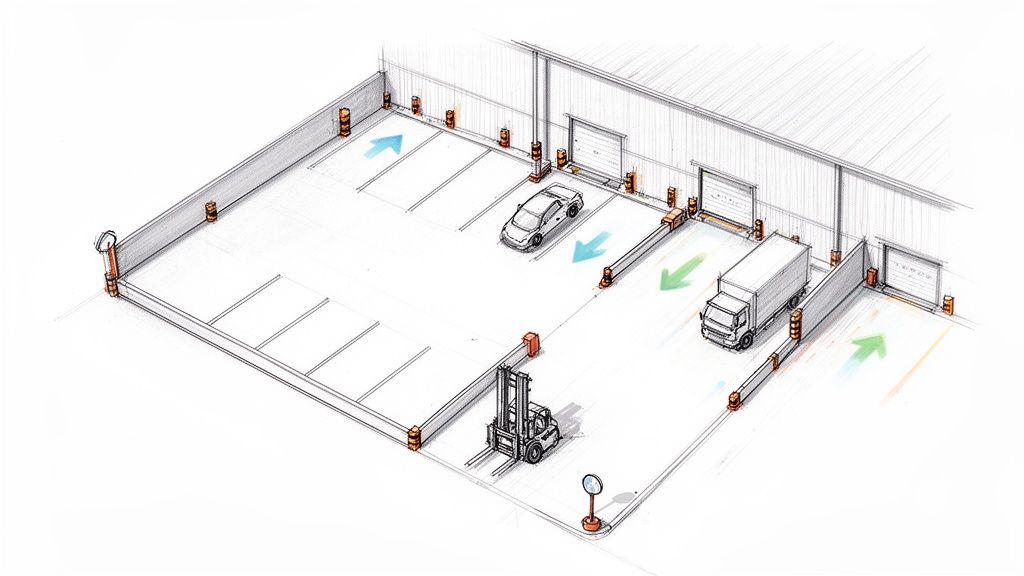
The first step is simply to identify where the biggest risks are. Every facility has its own weak spots, and they call for different types of protection.
Step 1: Identify your risk areas
Start by taking a walk through your facility. Where is vehicle traffic heaviest? And where are the margins at their tightest?
- Loading docks: An obvious high-risk zone. Heavy trucks back in and out, day after day. Damage to the dock edge and vehicles is more the rule than the exception. Here, heavy-duty D-shaped dock bumpers are a classic solution that withstands repeated impacts.
- Parking garages: Tight spaces and varying driver skills make walls, corners and columns extremely vulnerable. A combination of wall and corner guards, preferably with reflectors for extra visibility, is often the best choice.
- Warehouses and industrial facilities: Forklift traffic in narrow aisles creates constant risks to racking, machinery and load-bearing columns. A mix of floor-mounted and wall-mounted protection is often needed to secure the facility.
- Outdoor areas and driveways: Unprotected facades, downspouts or equipment along transport routes often take a beating for no reason. Longer rubber strips or dedicated hoop guards are a simple and effective way to prevent damage.
Step 2: Analyze the traffic
Once you know where the risks are, the next step is to understand what causes them. Ask yourself questions like: What types of vehicles operate here? How often? And at what speed? The answers are crucial in determining the protection you need.
A car parallel parking requires completely different protection than a fully loaded forklift on the move. Don’t forget the human factor either – stress, poor visibility or inexperienced drivers significantly increase the risk. In fact, speeding is a widespread problem, even on private property. It creates life-threatening situations where both vehicles and unprotected people are moving around.
Step 3: Assess the exact protection needs
Finally, specify exactly what needs to be protected. Is it a sharp concrete edge that needs a soft corner guard? Or is it a long wall that is constantly scraped by reversing cars?
Think of protection as a tailor-made insurance policy. Generic protection can miss the most critical points, while a carefully selected solution provides maximum protection exactly where it is needed most.
A load-bearing column in a warehouse, for example, may need heavy-duty, wrap-around protection, while a wall in a parking garage does just fine with a simpler rubber strip. Our guide to choosing the right impact protection for warehouses offers more practical tips for that type of environment.
By following these three steps, you get a clear picture of your needs and can more easily choose the right products for your business.
Doing a thorough analysis from the start saves both time and money. Not sure how best to protect your facility? Contact us at Nordguard for expert help. Our experts will help you identify the risks and develop a solution that lasts.
Practical tips for installation and maintenance
Rubber impact protection is never better than its mounting. You can have the most heavy-duty rubber profile on the market, but if it is loose or attached to a poor substrate, it does no good. Correct installation from the start is essential – it not only maximizes the protective effect but also extends the service life considerably.
Fortunately, both installing and maintaining rubber protection tends to be much easier than for other materials. The flexibility of rubber makes it easy to work with, and once it is in place, it requires minimal attention.
Prepare the substrate for maximum durability
A strong and stable mounting always starts with a well-prepared substrate. Cutting corners here is one of the most common reasons protection comes loose prematurely, especially in harsh environments. Whether you are mounting on concrete, brick or steel, the principle is the same: the surface must be clean, dry and even.
- Cleaning: Remove all dirt, oil, dust and loose material. A pressure washer or wire brush may be needed on really dirty surfaces.
- Inspection: Check that the substrate is intact. Are there cracks in the concrete or rust on a steel beam? Fix it before you mount.
- Leveling: An uneven surface creates unnecessary stress in the impact protection and weakens the mounting points. Fill holes and sand down uneven areas for a flat contact surface.
These steps don’t take long, but they make an enormous difference to the end result.
Choose the right mounting method
How you attach the protection depends entirely on its type and what it needs to withstand. A lighter wall strip in a parking garage obviously calls for a different method than a heavy dock bumper that has to handle trucks.
For heavier applications:
Mechanical fastening is the only way to go, period. Heavy-duty expansion bolts or concrete screws are standard for attaching substantial rubber profiles to concrete and brick. This ensures the protection stays rock solid and can absorb the energy of a collision without being torn loose. Make sure to drill holes of the correct diameter and depth for maximum strength.
For lighter installations:
For smaller protection, or on surfaces where you cannot drill, a special adhesive or high-performance mounting tape can work very well. However, it is essential to use an adhesive designed for both rubber and the substrate (concrete, metal, wood, etc.) and that it can handle the climate if installed outdoors. Always clean the surfaces thoroughly before gluing to get the best possible bond.
Easy maintenance for a long service life
One of the biggest advantages of rubber impact protection is that it practically takes care of itself. The material is so durable and weather-resistant that it needs very little attention. But with a few simple, regular checks, you can extend its service life even further and be sure the protection always works as it should.
We usually recommend a simple checklist for regular inspections:
- Visual check: Walk around and look for visible damage. Has the protection taken an unusually hard hit? Are there deep gouges or cracks?
- Check the mounting: Give the protection a gentle shake to make sure it is firmly attached. Tighten any bolts or screws that may have vibrated loose over time.
- Cleaning: Keep the protection free of dirt and oil. Usually, water and a brush are all it takes to make it look good again.
By making these simple checks part of your regular property inspection, you catch small problems before they turn into big, expensive ones. A small effort that provides great peace of mind.
Not sure which installation method is best for your project, or would you like advice on maintenance? Contact us at Nordguard for expert help. We make sure you get a solution that is correctly installed and built to last.
The benefits of rubber – for your wallet and the planet
Installing impact protection is about so much more than just stopping an impact. It is a smart investment that pays off on several levels – both financially and environmentally. When you choose rubber impact protection, especially one made from recycled material, you make a decision that benefits both your budget and our planet.
Many people focus solely on the purchase price of the protection, but the real calculation is about what it costs not to have it. Picture the invoice for repairing a cracked concrete column, a dented loading dock or a smashed wall. And don’t forget the repair cost for the forklift or truck that caused the damage.
These expenses often appear when you least expect them and can easily far exceed what a good protection system would have cost in the first place. Rubber simply acts as a buffer that takes the hit and absorbs the costs before they even arise.
An investment that pays off surprisingly fast
The most direct financial benefit of rubber impact protection is, of course, lower repair costs. Every time a vehicle bumps into soft rubber protection instead of a rock-hard wall, you avoid a potential invoice from a contractor or repair shop.
But there are more, less obvious, financial benefits:
- Lower insurance premiums: Insurance companies like it when you are proactive. A facility with a low claims history is often in a better negotiating position when it is time to review premiums.
- Fewer hassles and less downtime: A damaged loading dock or a blocked warehouse aisle means costly business interruptions. Reliable protection keeps everything running smoothly.
- Higher property value: An intact, well-maintained and safe property is simply more attractive on the market, whether it is being sold or leased.
The total return on investment (ROI) is therefore much more than just the avoided repair invoice.
Choosing rubber impact protection is not an expense, it is an investment in smoother and more predictable day-to-day operations. You replace sudden, high repair costs with a controlled, budgeted line item.
Sustainability that strengthens your brand
Beyond the money, there is another increasingly important piece of the puzzle: sustainability. Many of the best rubber protection products on the market are actually made from recycled material, often from old car tires. By choosing such a product, you help close the loop and contribute to a circular economy.
The environmental benefits are several. You ensure that less waste ends up in landfills, and you reduce your carbon footprint, since recycling requires significantly less energy than producing new material from scratch.
For municipalities, environmentally certified industries and property companies with a clear sustainability policy, this is a simple and concrete way to show they mean business. Being able to point out that you have actively chosen recycled and sustainable materials for your facility strengthens your brand. It is clear proof that you take responsibility – something that matters more and more to both customers and partners.
In other words, the investment delivers a triple win: increased safety for staff and property, lower costs over time and a concrete improvement in your environmental profile.
Explore our range of sustainable and effective protection solutions.
Not sure how best to combine financial and environmental goals? Contact us at Nordguard for expert help. We will help you find rubber impact protection that protects both your facility and the future.
Frequently asked questions about rubber impact protection
When it is time to invest in impact protection, questions almost always come up. Rubber is a fantastic material with many advantages, but the key is knowing how to use it correctly. Here we have gathered answers to the most common questions we encounter, to give you quick and practical guidance.
Which impact protection is best for a parking garage?
In a parking garage, a combination of different types of protection is almost always the smartest solution. Spaces are often tight, and traffic ranges from hesitant parallel parkers to fast delivery vans. You simply need to protect several different surfaces.
- Wall Protection: Longer wall surfaces, where cars drive alongside or park, are best protected with D-shaped rubber profiles or full-length wall strips. They effectively absorb impacts from car doors and bumpers and prevent unsightly scuff marks and damage to the concrete.
- Corner guards: Exposed columns and corners are the most critical points. A heavy-duty rubber corner guard, preferably with reflectors to be more visible in dim lighting, is essential. It can be the difference between a small scratch on a car and costly damage to a load-bearing structure.
By combining these, you protect both the building itself from unnecessary wear and the cars from dents and scratches.
How difficult is it to install rubber protection yourself?
It depends entirely on the type of protection. Many of the lighter profiles and corner guards can definitely be installed by anyone reasonably handy. They are often easily attached with a strong special adhesive or a few screws directly into the substrate.
But when it comes to heavier equipment, such as dock bumpers, it is a whole different story. They must be able to absorb the force of a reversing truck and therefore require rock-solid anchoring with expansion bolts in concrete. There are no shortcuts here – the installation instructions must be followed to the letter for the protection to do its job.
If you are the least bit unsure, always ask for advice. Incorrect installation can render the protection useless on the day an accident actually happens.
How long does rubber impact protection last outdoors?
Our rubber impact protection products are made from materials developed to withstand the Nordic climate. They are built to resist everything from blazing UV radiation in summer to ice, snow and rapid temperature changes in winter.
That is why you can expect a really long service life, often more than 10–15 years. Of course, this depends on how exposed the location is and how often impacts occur. Unlike steel, it does not rust, and unlike cheaper plastics, it does not dry out and crack in the sun. This makes rubber an extremely reliable and virtually maintenance-free choice for outdoor use.
Can rubber impact protection be ordered in custom lengths?
Absolutely! Flexibility is one of rubber’s great strengths. Many of our profiles and strips come in standard lengths that you can easily cut to the exact size on site with an ordinary saw.
For larger projects or where millimeter precision is required, we can also arrange custom lengths directly from the factory. This is often a smart way to minimize waste and make installation even easier.
Do you have other questions, or do you need help finding the right rubber impact protection for your property? Our experts at Nordguard can help you with everything from assessing your needs to choosing the right product and mounting. Get in touch today for personalized advice.
Ready to take the next step?
We help you develop solutions tailored to your needs. At Nordguard, we strive to make the ordering process as smooth as possible. By offering support and guidance throughout the entire purchasing experience, we make sure you feel confident and satisfied with your choice of protection products.+46 10 153 90 50
[email protected]