
Wall Impact Protection: A Complete Guide to a Safer Workplace
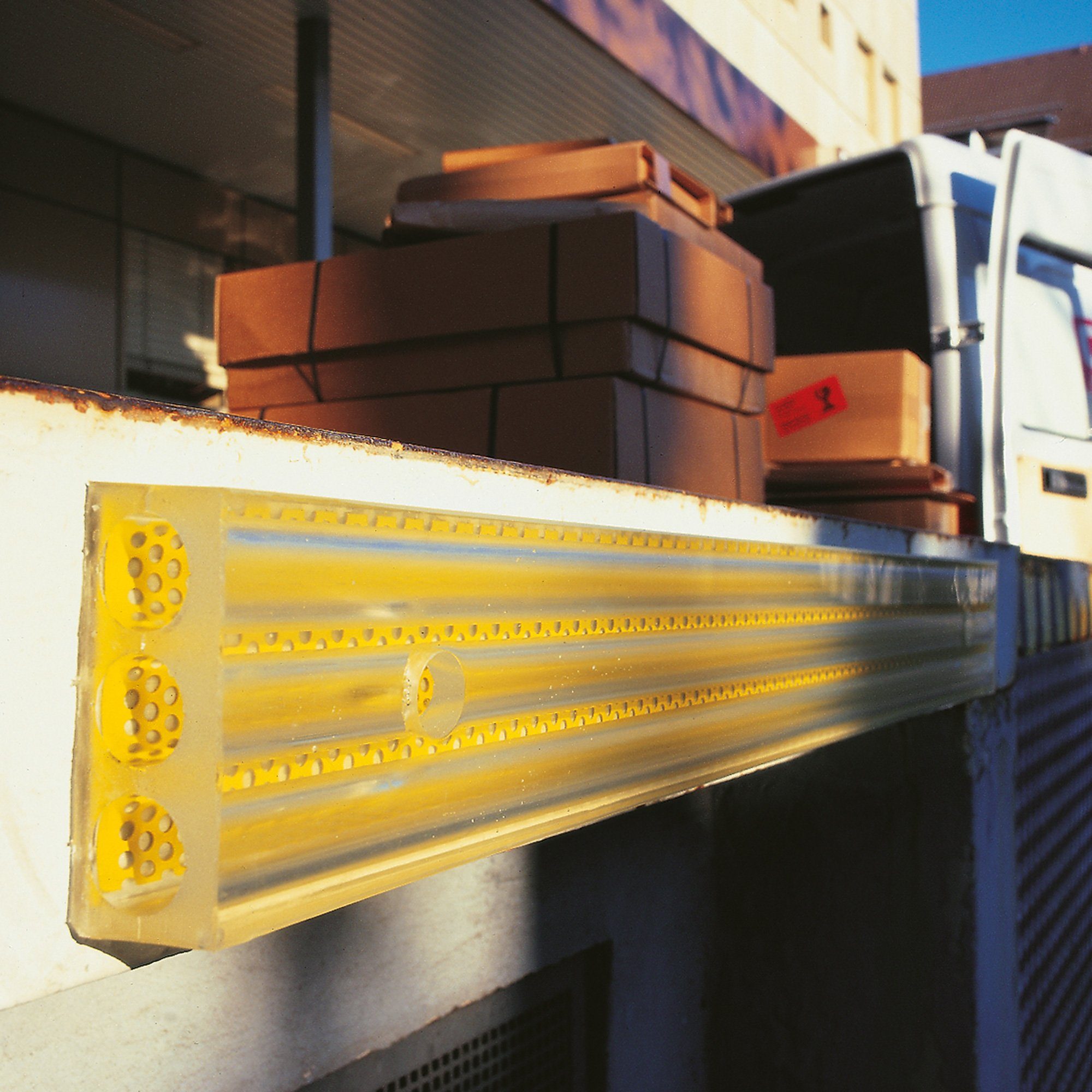
A forklift backing straight into a wall is every warehouse manager’s nightmare. It’s about much more than an ugly dent. In practice, it means costly repairs, unplanned downtime and, worst of all, a safety risk for your staff. Impact protection for walls is the crucial barrier that turns a potential disaster into a manageable incident.
How to protect your walls from costly damage
A damaged wall in a warehouse, an industrial facility or a parking garage is rarely just a cosmetic problem. Behind that crack or dent lies a whole chain of costs and headaches. Proactively installing the right protection, such as heavy-duty protective beams or safety railings, is actually one of the most profitable investments you can make in your facility’s operations and safety.
Every collision, whether it’s a truck clipping a loading dock door or a pallet jack bumping into a warehouse aisle, creates both direct and indirect costs. The direct costs are easy to see: repairing the wall, damage to the vehicle and perhaps scrapped goods. But it’s the indirect costs that often hurt the most.
More than just a dent in the wall
Consider the hidden consequences of a seemingly minor accident:
- Downtime: The area around the damage often has to be cordoned off. In the worst case, this can halt entire production or logistics flows.
- Safety risks: Damage to a load-bearing wall is no laughing matter. It can affect the stability of the entire building and pose an immediate hazard.
- Administrative hassle: Accidents eat up time. They have to be investigated, handled with insurance companies and repairs have to be planned – all time taken away from your core business.
- Higher insurance premiums: Repeated damage is a red flag for insurers, which can lead to more expensive premiums.
Since the early 2010s, the pace of goods handling in Sweden has increased markedly, and with it the need for effective impact protection. According to statistics from the Swedish Work Environment Authority, forklifts are the work equipment that causes the most reported workplace accidents. Nearly 800 people every year are injured so badly that they have to go on sick leave. Investing in impact protection is therefore not just a way to protect your property, but an absolutely essential measure for a safer workplace. Also read our guide on common damage prevented by impact protection.
Seeing impact protection as a pure cost is a mistake. Instead, see it as insurance against unforeseen expenses, downtime and, most importantly, accidents that can injure your staff.
Not sure which risk zones exist in your facility or which protection is the best fit? Contact us for a free needs assessment. Our experts will help you map the risks and propose concrete solutions – before an accident happens.
Which type of impact protection is right for your business?
Choosing the right impact protection isn’t about finding a one-size-fits-all solution. Every facility is unique, with its own traffic flows, risks and requirements. The right choice is about matching the protection to the environment, whether it’s a busy loading dock, a parking garage or a clinically clean production area.
To grasp the differences, a simple analogy helps. Heavy-duty steel impact protection, such as a protective beam, is like the bumper on a heavy truck. Its main job is to take the hit and divert the enormous force of a collision with a forklift. The goal is to protect what’s behind it – a load-bearing wall, expensive equipment or critical installations.
Flexible polymer impact protection works more like a modern, resilient shield. It’s built to handle light to medium impacts from pallet jacks, shopping carts or smaller forklifts. On impact, it springs back to its original shape, minimizing damage to both the vehicle and the protection itself. In addition, the material is easy to keep clean and resists chemicals, making it perfect for hygiene-sensitive environments in the food and pharmaceutical industries.
Comparison of impact protection for different environments
To make the choice a little easier, we’ve put together a quick overview. The table below helps you quickly see which protection fits best depending on the environment, type of traffic and what you primarily need to protect.
Comparison of impact protection for different environments
| Type of protection | Main material | Ideal environment | Withstands traffic type | Primary benefit |
|---|---|---|---|---|
| Protective beam | Steel | Warehouses, loading docks, industry | Heavy forklifts, trucks | Maximum protection against high forces |
| Protective plank | Polymer/Plastic | Food industry, cleanrooms, cold rooms | Pallet jacks, carts, lighter forklifts | Flexible, hygienic, low maintenance |
| Bollards/Posts | Steel/Plastic/Rubber | Parking garages, stores, walkways | Cars, shopping carts | Point marking, demarcation |
| Wall Protection/Strips | Rubber/Plastic | Parking garages, corridors | Cars, transport carts | Protects against scratches and minor impacts |
As you can see in the table, material and design are absolutely decisive. Impact protection for walls in a parking garage needs to handle low, scraping hits from cars, while protection in a warehouse aisle must be able to stop a fully loaded forklift. The choice is anything but random.
The process from identifying a risk to implementing the right protection can be visualized as a simple decision tree.
The image clearly shows that everything starts with a thorough analysis of the specific threats in your particular environment.
Freestanding or wall-mounted protection?
Another important question is how the protection should be mounted.
Freestanding protection is mounted directly in the floor, a short distance from the wall. This is the most robust solution, since all collision force is absorbed by the floor anchoring, preventing any energy from reaching the wall itself. It’s the standard choice in environments with heavy traffic.
Wall-mounted protection, such as strips or panels, is attached directly to the wall. It’s perfect for preventing surface damage such as scratches and minor dents from carts and lighter vehicles, but it doesn’t provide the same structural protection that a freestanding system can.
Choosing the right type of impact protection isn’t just a technical question – it’s a strategic investment in safety and operational efficiency. The right choice minimizes the risk of costly repairs and unplanned downtime.
Whether you need to protect a concrete wall in a warehouse, a panel wall in a cold storage terminal or a brick wall in a parking garage, there’s a solution. The key is to understand the forces at work in your facility and choose a system that’s rated for the task.
Not sure which impact protection for walls best solves your challenges? Our experts are ready to help you with a professional needs assessment and advice. Contact us today and let’s talk about how we can create a safer environment for your business.
Choosing the right material for maximum durability
The choice of material is the single most important factor for your impact protection’s performance and service life. Impact protection for walls shouldn’t just be strong – it also has to be suited to the specific environment it will operate in. Let’s take a deeper look at the three most common materials: steel, polymer and composite.
Understanding the differences is key to making a smart investment. The choice affects everything from maintenance needs to how well the protection handles moisture, chemicals and temperature fluctuations.
Steel – the robust original
Steel is the classic choice, especially in heavy industry and logistics. Its unmatched strength makes it the obvious option where the risk of collisions with heavy vehicles such as forklifts and trucks is high.
Properly sized and installed steel impact protection acts as an unyielding shield for walls, columns and sensitive equipment. Its biggest advantage is its ability to absorb and distribute enormous forces. The drawback is that it can be permanently deformed by a hard enough hit and then need to be repaired or replaced to regain its full function.
Polymer – the flexible challenger
Polymer, often called high-density plastic, is a modern and increasingly popular material. Unlike steel, polymer is flexible and has a kind of "memory". This means it can absorb the energy of an impact, deform and then return to its original shape.
This property makes polymer ideal for environments with light to medium traffic, such as pallet jacks and transport carts. The material also has several other aces up its sleeve:
- Corrosion-resistant: Polymer doesn’t rust, making it perfect for outdoor use, cold rooms and facilities with a lot of moisture or chemicals.
- Hygienic: The smooth surface is easy to clean and resists bacterial growth, a requirement in the food and pharmaceutical industries.
- Through-colored: Any scratches are less visible since the material has the same color all the way through, reducing the need for touch-up painting.
Want to dig deeper into the pros and cons? Read our comparison article on material choices for impact protection.
Finishes that protect your investment
For steel protection, the finish is crucial for resisting wear and corrosion. Two methods are particularly common and effective for extending the service life of impact protection for walls.
Table of common finishes for steel
| Finish | Process | Main benefit | Ideal environment |
|---|---|---|---|
| Hot-dip galvanizing | The steel is dipped in a bath of molten zinc. | Unbeatable rust protection, even when scratched. | Outdoors, parking garages, damp environments. |
| Powder coating | A colored powder is applied and cured in an oven. | Durable surface with high visibility (often yellow). | Indoors in dry industrial facilities and warehouses. |
The methods are often combined, with hot-dip galvanized protection also being powder-coated to achieve both maximum rust protection and high visibility. This is standard for products that need to withstand harsh outdoor environments with road salt and changing weather.
Choosing a material is like choosing tires for a car. You don’t pick the same tires for a race track as for a muddy forest road. In the same way, you need to match your impact protection to the specific risks and conditions in your facility.
Navigating materials, finishes and designs can feel overwhelming. Our experts have in-depth knowledge of how different materials perform in different environments. Contact us for a free consultation, and we’ll help you choose the most durable and cost-effective solution for your specific needs.
How to ensure a correct installation
First-class impact protection for walls is only half the job. A sloppy installation can render even the most robust protection completely useless when the hit actually comes. Knowing the basics of mounting is therefore absolutely essential for your investment to deliver the protection it actually promises.
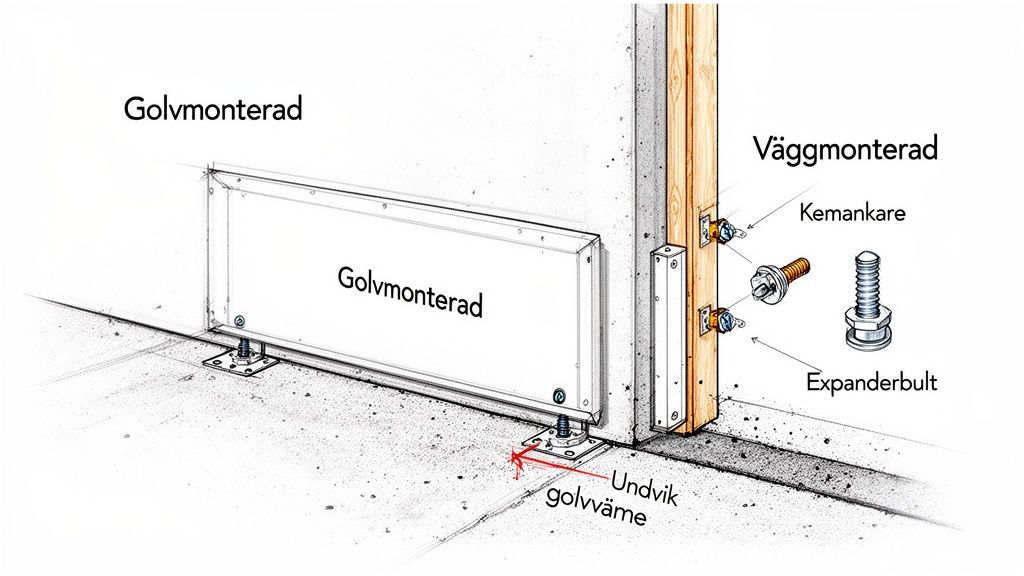
By far the most common and safest method is to mount the protection freestanding in the floor, a short distance in front of the wall. This creates a completely independent protective barrier. All the force from a collision is then absorbed by the protection and its floor anchoring, preventing the energy from transferring to and damaging the building structure itself.
Choosing the right anchoring for your substrate
The substrate is the be-all and end-all of an installation that lasts. Different materials place completely different demands on anchoring to ensure the protection stays rock-solid and can handle the forces it’s built for.
- Concrete floors: This is the ideal substrate. Here, expansion bolts or chemical anchors are almost always used. Expansion bolts are a quick and strong solution, while chemical anchors provide an even stronger, completely vibration-free hold – preferable for really heavy-duty applications.
- Asphalt: Anchoring in asphalt is trickier, since the material is softer and affected by temperature. Special solutions are often required here, such as casting a small concrete foundation under the asphalt where the protection will stand.
Gambling on the wrong type of bolt is like building a house on a poor foundation. In a collision, the anchoring is the weakest link. If it gives way, the protection has completely lost its function.
Avoid the most common installation mistakes
Even with the right material, it’s easy to make costly mistakes. Careful preparation and a little forethought are the key to a successful installation.
Checklist for a safe installation:
- Check for underfloor heating: Never drill into a floor without being 100% sure there are no heating coils or other embedded systems. Use drawings or a thermal camera to be on the safe side.
- Correct distance to the wall: Leave enough space for the protection to flex on impact without hitting the wall behind it. Always follow the manufacturer’s recommendations.
- Clean the drill holes: Dust and concrete debris in the drill holes can dramatically weaken the anchoring, especially when using chemical anchors. Use a brush and compressed air to get the holes completely clean.
- Correct tightening torque: Tighten the bolts to the torque specified by the manufacturer. Too loose and the protection becomes unstable; too tight and you risk damaging the bolt or cracking the concrete.
Making sure the installation complies with applicable standards and regulations is also a critical part of creating a safe work environment. For a more in-depth review, read more in our article on regulations and standards for impact protection.
A properly performed installation is a craft. It requires knowledge of materials, an understanding of the forces involved and precision in every step. To ensure your impact protection for walls actually does its job when an accident happens, we of course offer professional installation.
Don’t let improper mounting compromise safety. Contact us today and our certified experts will make sure your protection is installed professionally for maximum safety and performance.
A maintenance plan that safeguards your investment
Installing impact protection for walls is a smart move to protect your facility, but the job doesn’t end there. For the protection to do its job year after year – and give you full value for your money – you need a simple but well-thought-out maintenance plan. Think of maintenance as an active part of your safety work; it’s the key to safe and cost-effective operations.
Just as your car needs servicing to stay safe on the road, impact protection requires regular inspection. It’s not about complicated work, but about creating a routine for finding and fixing small problems before they grow big and expensive. A small dent may seem harmless, but it can be a sign that the protection’s structure is weakened and will no longer provide adequate protection on the next impact.
Create a routine for visual inspection
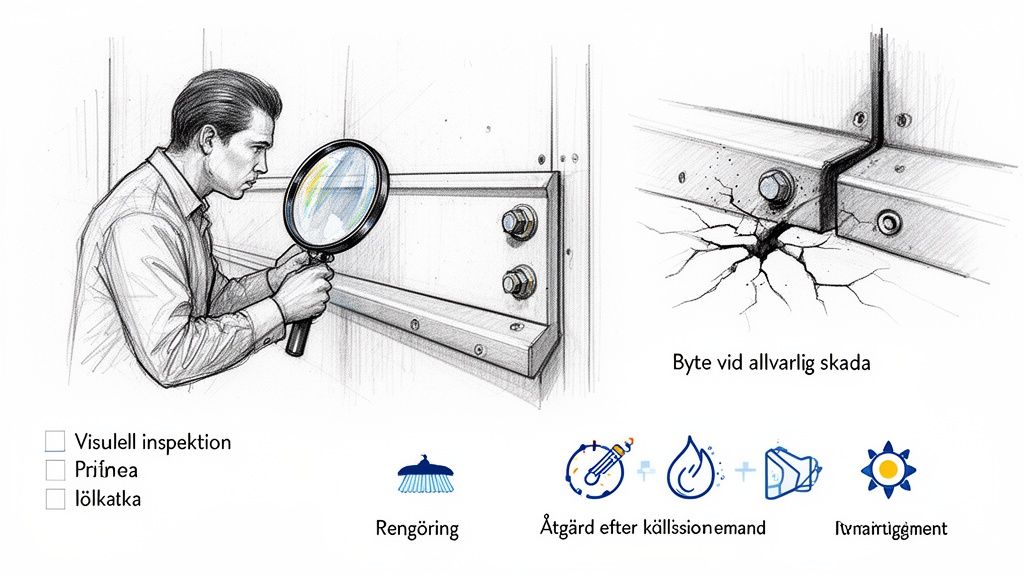
The foundation of any maintenance plan is regular visual inspection. By scheduling a quick inspection round, perhaps monthly or quarterly depending on how much traffic you have, you can catch problems in time.
A quick inspection checklist:
- Look for damage: Are there dents, cracks or bent sections? Even small deformations can impair the protection’s ability to absorb force.
- Check the anchoring: Make sure all bolts and screws are secure. Vibrations from forklifts and vehicles can cause mountings to loosen over time.
- Examine welds: If the protection is welded, look closely at the welds. Are there signs of cracking or rust?
- Assess the surface: Keep an eye out for chipped paint, rust spots or other corrosion. Damage to the surface layer can weaken the material, especially in damp environments.
Cleaning is about more than appearance
Clean impact protection is safer impact protection. It may sound obvious, but dirt and oil can effectively hide damage and make the protection less visible. The yellow and black warning color is there for a reason, but its effect quickly disappears under a layer of dust.
In most cases, a little water and a mild detergent go a long way toward keeping the protection looking good and continuing to serve its purpose.
Neglecting maintenance on impact protection is like relying on a fire extinguisher that’s past its expiration date. It’s there, but you can’t be sure it will work when it really matters. Regular inspection is your guarantee that the protection is ready.
After a collision – repair or replace?
Once an accident has happened, it’s important to act immediately. The question is whether a repair is enough or whether the entire protection needs to be replaced. That depends entirely on how extensive the damage is.
In these cases, a repair may be enough:
- Small, superficial dents in steel protection that haven’t affected the anchoring or the load-bearing structure.
- Chipped paint that can easily be sanded down and repainted to restore the rust protection.
But in these cases, replacement is necessary:
- Major deformations, cracks or creases in the material. Steel protection that has been bent and then straightened has lost a large part of its original strength.
- Damage to the anchoring points in the wall or floor.
- When polymer protection has cracked or been permanently deformed. Polymer protection cannot be "straightened".
Having access to spare parts is essential for quickly restoring safety. At Nordguard, we have a complete range of spare parts and can also offer service agreements that give you worry-free, long-term protection for your facility.
Not sure about the condition of your current protection, or want to discuss a service agreement? Contact our experts today and we’ll help you put together a plan that fits your specific needs.
Frequently asked questions about impact protection for walls
Here we’ve gathered some of the most common questions we get from property owners, warehouse managers and project managers. The answers are straightforward and simple, so you can quickly get the full picture and make the right decision about impact protection for walls.
Getting the details right is essential for the protection to actually do its job – from placement and regulations to how it should be anchored. Think of this section as a quick guide to clearing up the most common questions.
How far from the wall should the protection be mounted?
A really good rule of thumb is to leave enough space for the protection to deform on impact without even touching the wall behind it. Exactly how much distance is needed depends entirely on the protection’s material and design. Flexible polymer protection may need more room to move than rigid steel protection.
Always check what the manufacturer recommends. But as a general starting point, you can count on a gap at least equal to the protection’s own thickness creating a safe protective zone.
Is CE marking required for impact protection?
This is a common and important question. The answer is that not all impact protection is classified as a construction product under the EU Construction Products Regulation (CPR), so there is no general requirement for CE marking.
However, CE marking is a strong mark of quality. It shows that the product has been thoroughly tested according to common European standards. It provides extra peace of mind and ensures that the protection meets high requirements for both safety and performance – something we at Nordguard always prioritize.
Choosing a CE-marked product is like choosing a car with a five-star Euro NCAP rating. It’s not always a legal requirement, but it’s a clear signal that safety has been taken very seriously.
Can impact protection be mounted directly on a drywall?
The answer here is a short and uncompromising no. We strongly advise against mounting impact protection directly on drywall. Drywall simply lacks the load-bearing capacity needed to handle the force of a collision.
A bracket in drywall would be torn loose on the first impact, rendering the protection completely pointless.
If you have drywall, one of these two methods always applies:
- Floor mounting: Install freestanding, floor-mounted protection in front of the wall. This is by far the safest and most recommended method.
- Anchoring in studs: If wall-mounted protection is still the only option, it must be securely anchored in the steel or wood studs behind, never in the drywall panel itself.
By following these principles, you ensure that your investment in impact protection for walls actually provides the protection you’re counting on. Improper installation isn’t just a waste of money – it’s a genuine safety risk.
Do you have more questions, or do you need expert help finding and installing the right protection? Our team at Nordguard has the knowledge and experience needed to guide you in the right direction, from the initial needs assessment to the finished installation. Contact us today for personalized advice.
Ready to take the next step?
We help you develop solutions tailored to your needs. At Nordguard, we strive to make the ordering process as smooth as possible. By offering support and guidance throughout the entire purchasing experience, we make sure you feel confident and satisfied with your choice of protection products.+46 10 153 90 50
[email protected]