
A Complete Guide to Choosing the Right Traffic Bollard
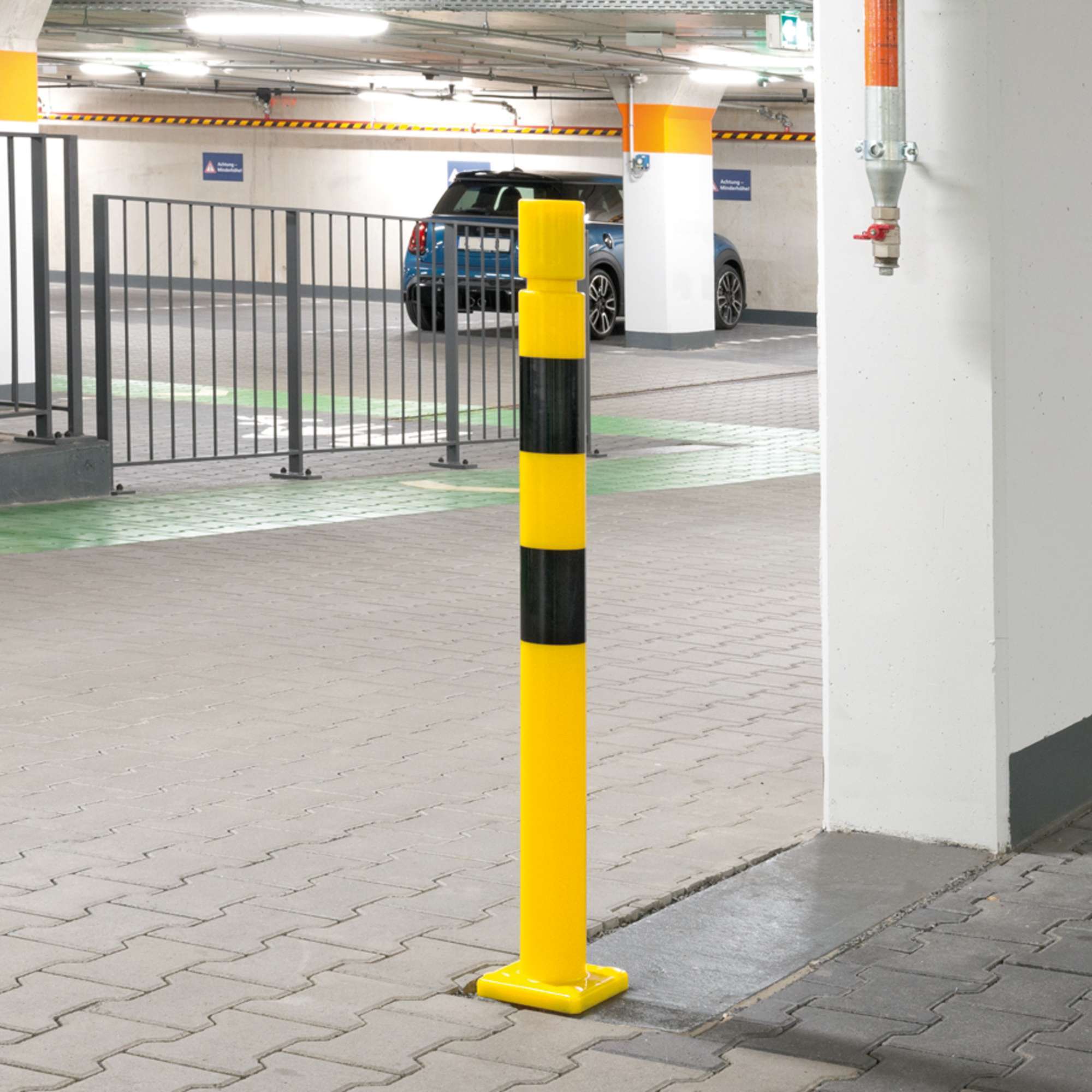
A traffic bollard is far more than just a post in the ground. Think of it as a silent guardian that creates safe, well-organized spaces. In its simplest form, it is a robust physical barrier that protects people and property from vehicle traffic while discreetly guiding traffic flow.
What Is a Traffic Bollard and How Does It Create Safety?
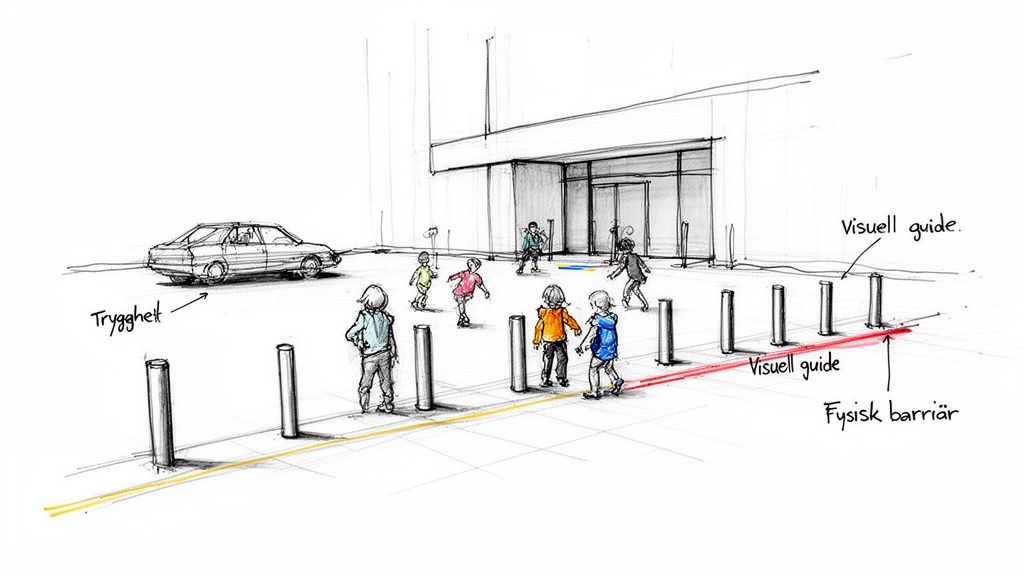
The traffic bollard plays a dual role in our shared spaces. It is both an active safety device and a subtle design element that creates order without feeling intrusive. Picture a busy town square where bollards keep cars out of pedestrian areas so children can play freely and safely. Or a store entrance where they effectively prevent illegal parking that blocks the doorway.
This dual function is the result of a long evolution in traffic safety. When car ownership exploded in the 1960s, accident statistics soared. Between 1964 and 1966, more than 1,300 people were killed each year on Swedish roads, a figure that forced entirely new safety measures. This critical period led to major investments in infrastructure, where physical barriers such as bollards became a key component in protecting vulnerable road users.
Basic Types of Bollards
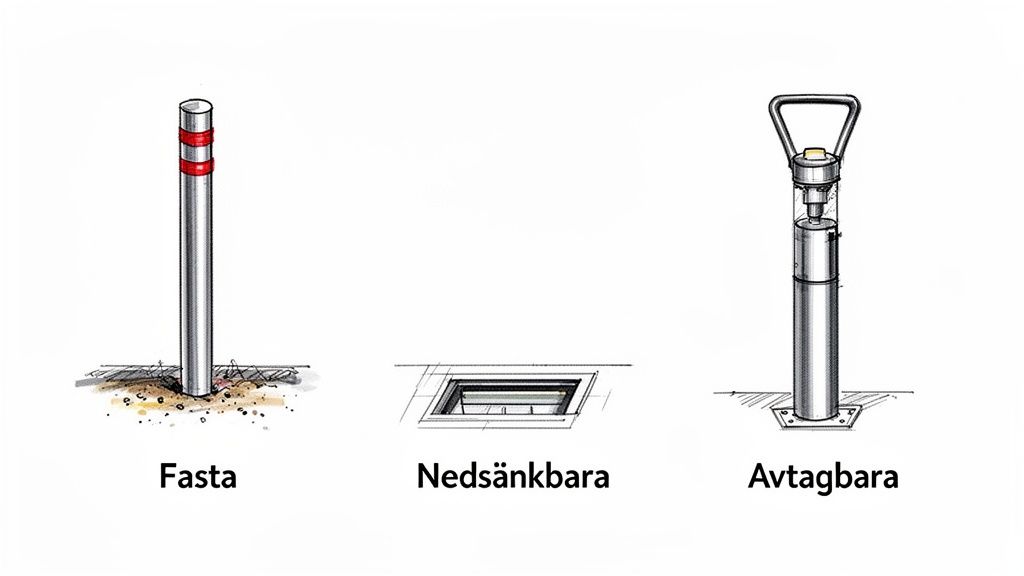
To understand how a bollard can solve a specific problem, you need to know the three basic categories. Each type is designed for different needs in terms of flexibility and level of protection.
- Fixed Bollards
These are permanently installed and form a constant barrier. They are ideal for locations that require permanent protection, such as outside schools, along bike lanes or to protect vulnerable parts of buildings. - Removable Bollards
A flexible solution that can be removed when needed to temporarily open a passage. Perfect for service entrances, marketplaces or parking areas where authorized vehicles occasionally need access. - Retractable Bollards
This is the most dynamic solution, where the bollard is lowered into the ground, either manually or fully automatically. They are often used on pedestrian streets, squares and event areas where you want to switch quickly between open and closed access.
Choosing the right type of bollard is absolutely critical. The wrong model can either create unnecessary obstacles or, even worse, give a false sense of security.
By understanding these basic differences, you build a solid foundation for making the right decision. Despite its small size, the choice of bollard has major consequences for both safety and function, which you can read more about in our article on bollards in projects.
Not sure which type of traffic bollard best meets your requirements? Contact us at Nordguard. Our experts will help you analyze your needs and recommend a solution that guarantees both safety and function.
Understanding the Different Types of Traffic Bollards
Choosing the right traffic bollard is all about understanding its purpose and the environment it will operate in. A solution that is perfect for a pedestrian street can be completely wrong for an industrial entrance. To make a good decision, we need to dive into the most common categories and understand their unique strengths and weaknesses.
The choice is rarely between "good" and "bad," but rather between different levels of flexibility, security and cost. Each type is built to solve a specific challenge, from creating permanent protection zones to enabling dynamic traffic control.
Fixed Bollards – The Permanent Guardian
Fixed bollards are the most basic and robust solution. They are permanently installed in the ground, usually set in concrete, to create an immovable barrier that constantly protects an area. Think of them as a permanent part of the infrastructure.
Their main strength is precisely that they are permanent. They require minimal maintenance and offer a high level of passive protection around the clock. This makes them ideal for:
- Protecting store entrances and facades from vehicle impact.
- Separating bike lanes and sidewalks from car traffic.
- Securing sensitive areas such as schoolyards and public squares.
The obvious drawback is the lack of flexibility. Once a fixed bollard is in place, it is there to stay, making it unsuitable for locations that require temporary vehicle access.
Retractable Bollards – Flexibility at the Highest Level
When access needs are dynamic and recurring, retractable bollards are the most advanced solution. With the push of a button, a remote control or an access control system, these bollards can disappear completely into the ground to open a passage, and then rise again to restore the barrier.
This makes them the premium choice for environments that require both high security and smooth access control. You often see them on pedestrian streets where deliveries must take place at certain times, at entrances to event areas or securing exclusive residential areas. They offer an unbeatable combination of security and convenience, but come with a higher price tag and require regular servicing.
Removable and Fold-Down Bollards – The Practical Compromise
Between the fully permanent and the fully automatic solutions are removable and fold-down bollards. These offer an excellent compromise between security, flexibility and cost, which has made them a very popular option.
- Removable bollards lock into a ground socket and can be lifted out completely with a key when passage is needed.
- Fold-down bollards are mounted on a hinged base plate and simply fold down to the ground.
Both variants are perfect for locations that need occasional access, such as service entrances, private parking spaces or temporarily reserving a parking space. They are significantly less expensive than retractable models but require manual handling.
The choice between these bollard types affects not only safety and flow on site, but also long-term operating costs and maintenance needs. A thorough needs assessment is therefore the first step toward a successful investment.
To give you a clearer picture of how the different types compare, we have put together a simple comparison.
Comparison of Different Types of Traffic Bollards
The table below provides a quick overview comparing the most common bollard types. Use it as a guide to see which type best matches your requirements for flexibility, security, typical applications and installation.
| Bollard Type | Flexibility | Security Level | Typical Application | Installation |
|---|---|---|---|---|
| Fixed | Low (Permanent) | High | Facade protection, pedestrian streets | Set in concrete |
| Retractable | Very high (Automatic) | Very high | Dynamic zones, event areas | Complex, requires power/drainage |
| Removable | Medium (Manual) | Medium-High | Service entrances, parking spaces | Ground socket |
| Fold-Down | Medium (Manual) | Medium | Private parking, temporary barrier | Surface mounting |
As you can see, there is no one-size-fits-all solution – it all depends on the specific situation. A fixed bollard provides maximum protection at a low cost, while a retractable bollard offers unbeatable convenience when access is a priority. Removable and fold-down variants are often the happy medium.
Below is a selection of traffic bollards from our range that represent these categories.


Navigating these options can feel overwhelming. Not sure which bollard best solves your challenge? Don’t hesitate to contact us at Nordguard. Our experts will help you analyze your specific needs and recommend a solution that is safe, functional and cost-effective.
How Material and Anchoring Affect Bollard Performance
A traffic bollard is never stronger than its weakest link. Even the most robust bollard is useless if the material is not up to the job or if the anchoring gives way in a collision. Understanding how these two elements – material and anchoring – work together is essential for a solution that delivers real safety and performs over the long term.
The choice is about finding the right balance between impact resistance, weather resistance, maintenance and appearance. It is a technical assessment that must be based on the unique conditions of the site. A bollard at a schoolyard has completely different requirements than one protecting an industrial door.
Material Choice Is the Foundation of Performance
The material determines not only how the bollard looks, but also its ability to withstand force, rust and wear over time. Each material has its own strengths, making it suitable for different environments and purposes.
-
Stainless steel: Known for its superior rust resistance and modern look. Stainless steel is a premium choice that requires minimal maintenance and looks good year after year, perfect for urban environments and prestigious locations.
-
Cast iron: A classic and extremely durable material often used for traditional and decorative bollards. Cast iron has high compressive strength and a robust character that blends in nicely in historic settings.
-
Steel (hot-dip galvanized/powder-coated): A very common and cost-effective option that provides high strength. Hot-dip galvanizing provides strong rust protection, and powder coating lets you get the bollard in any RAL color to match its surroundings.
-
Plastics and polymers: Often used for flexible bollards or as protective covers. These materials can spring back to their original shape after a minor impact and are excellent for marking lanes or as protection in low-speed environments such as parking garages.
Choosing the right material is a fundamental part of the specification. For a deeper analysis of how the different materials perform, read our guide to choosing materials for impact protection.
A bollard is part of a larger safety strategy. Bollards are one of many pieces of the puzzle that together have contributed to a dramatic improvement in traffic safety in Swedish cities.
Stockholm is a clear example of this positive development. In 1914, 20 traffic deaths were recorded, but during the period 2009–2018 the figure had dropped to an average of only 10 people per year – despite an enormous increase in traffic. This is the result of systematic investments in safer infrastructure, where bollards play an important role in protecting vulnerable road users. Read more about traffic development in Stockholm on Stockholmskällan.
The Critical Role of Anchoring in Safety
A bollard is never stronger than its anchoring in the ground. It is the anchoring that transfers the force of a crash into the substrate and ensures the bollard stays in place. Improper anchoring can render even the strongest bollard completely useless.
There are three main anchoring methods, each with its own advantages and disadvantages.
Methods for Anchoring Traffic Bollards
| Method | Description | Best Suited For |
|---|---|---|
| Cast-in-place | The bollard is set directly into the ground with concrete. | Maximum strength and permanent installations, especially in asphalt and softer ground. |
| Surface mounting | The bollard is bolted with expansion anchors into an existing, stable surface. | Simpler and faster installation on solid concrete surfaces where digging is not an option. |
| Precast foundation | A precast concrete foundation is buried, and the bollard is then mounted in it. | Streamlines installation and ensures correct anchoring, common for removable bollards. |
Choosing the right method requires an assessment of ground conditions, the level of protection needed and the installation budget. If you need to stop a heavy vehicle, cast-in-place is almost always the only option. For simple separation on a concrete deck, surface mounting may be more than enough.
Below is a selection of products in various materials suitable for different types of anchoring.
Specifying the right material and anchoring can be complicated. Contact us at Nordguard for expert help. We analyze your conditions and help you choose a traffic bollard with anchoring that guarantees function and safety throughout its service life.
Choosing the Right Bollard for Specific Environments
Theory is one thing, practice another. Knowing about materials and bollard types is a good foundation, but the real challenge is finding the right solution for a specific need. A bollard that is perfect outside a school rarely works as well at a busy industrial door. Every environment has its own unique requirements – from appearance and flexibility to sheer impact resistance.
That is why you should always start with a simple question: "What problem should the bollard solve, and where?" The answer to that question then guides everything, from the material we choose to how the bollard is anchored in the ground.
The flowchart below shows a simple way of thinking, based on the most basic question of all: what level of protection is needed?
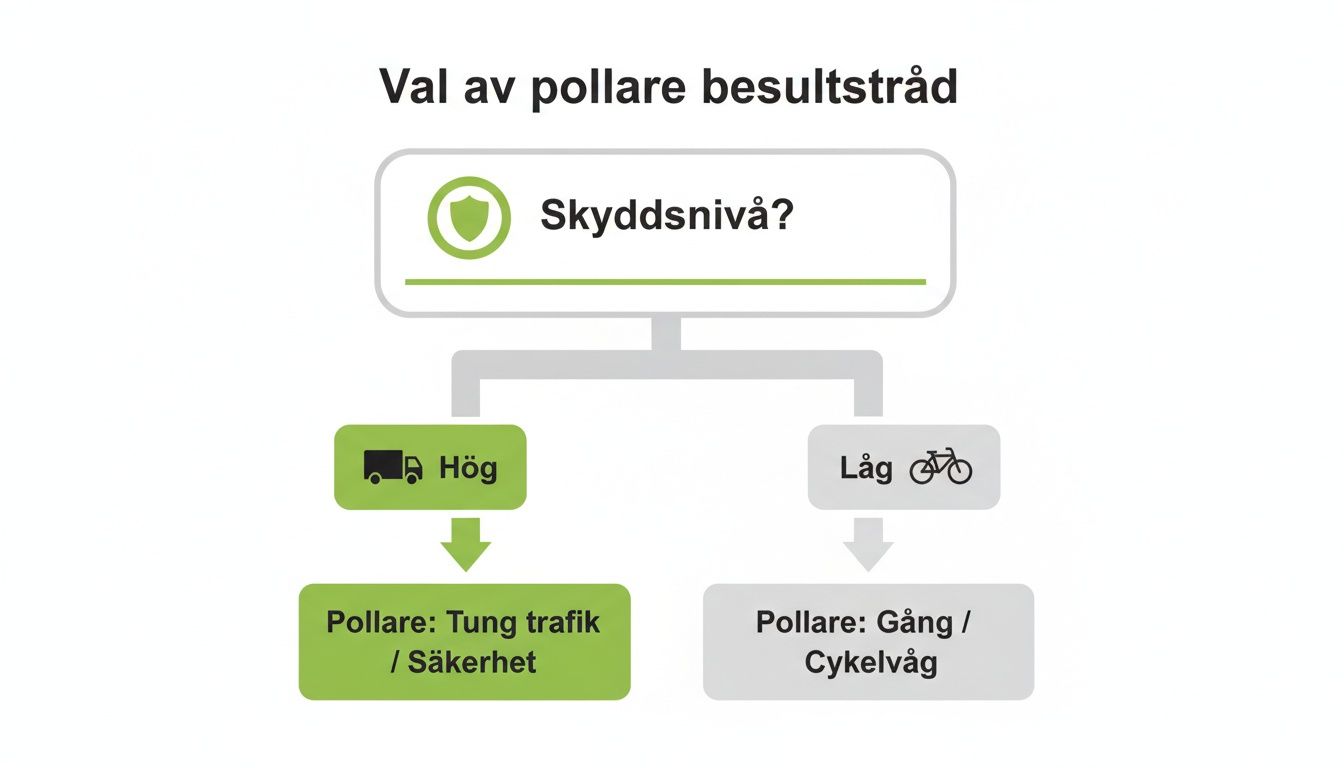
As the image shows, low protection needs usually involve guiding the flow of people and lighter vehicles. When protection needs are high, however, robust barriers that can actually stop a vehicle are required.
Bollards for Municipalities and Public Spaces
For municipalities and urban planners, it is a constant balancing act between safety and aesthetics. A bollard in a public space should not only protect – it must also fit into the cityscape and feel welcoming.
- Squares and pedestrian streets: Here you want to protect pedestrians from car traffic without it feeling like a fortress. Decorative bollards in cast iron or stainless steel are often used. To easily let in delivery or service vehicles, automatic retractable bollards are an excellent, if more expensive, solution.
- Schoolyards and preschools: Here, children’s safety is the top priority. Fixed, heavy-duty bollards create a clear and permanent protection zone against busy streets. Colorful models are often chosen to make them extra visible and create a friendlier environment.
- Bike lanes: To separate cyclists from cars, flexible bollards are a smart choice. They mark a clear boundary but give way in the event of an accident, reducing damage to both vehicle and cyclist.
Solutions for Property Owners and Housing Associations
For a property owner or housing association, it usually comes down to two concrete problems: preventing unauthorized parking and protecting the building’s facade.
Here, flexibility and simplicity are key. Fold-down or removable bollards are incredibly popular for reserving parking spaces. They are easy to handle for anyone with a key, but an effective stop for everyone else. To protect facades, doors or building corners from vehicle impact, fixed bollards are the most reliable and cost-effective solution.
For a housing association, a fold-down bollard is a simple investment that immediately solves the frustration of an illegally occupied parking space. It is as much about keeping order as it is about safety.
Protection for Industry, Warehousing and Logistics
In industrial environments, function and durability are what count, period. Aesthetics are secondary – a bollard here must withstand really rough treatment and protect critical equipment, doors and personnel from heavy vehicles such as forklifts and trucks.
- Impact protection: Heavy-duty steel tubes with a large diameter and thick walls are standard. They are often filled with concrete for extra resistance.
- High visibility: The bollards are almost always powder-coated in safety colors such as yellow or orange for maximum visibility in busy, cluttered environments.
- Strong anchoring: Cast-in-place is the dominant anchoring method here. It is the only way to guarantee that the bollard can withstand a serious hit.
Whatever environment you work in, there is a bollard designed for that exact purpose. Below is a selection of products covering everything from attractive urban settings to demanding industrial zones.
Finding your way through the jungle of options can be difficult. Contact us at Nordguard and our experts will help you analyze your needs and find the perfect solution that balances safety, function and budget.
Ensure Function and Service Life with Proper Installation and Maintenance
A traffic bollard is a long-term investment in safety, but its real value depends entirely on proper installation and maintenance. A carelessly installed bollard can, in the worst case, create a false sense of security, while a little regular inspection can double the product’s service life. It is simply about making sure the bollard does what it was built for, year after year.
The process begins long before the bollard itself is even in place. Thorough preparation is essential for a durable result, especially for cast-in and automatic systems. This is where the foundation is laid for the bollard’s stability and future performance.
Critical Steps in the Installation Process
Installing a traffic bollard is so much more than just digging a hole. Every step must be carried out with precision for the bollard to live up to its protection rating and function. Following the manufacturer’s instructions to the letter is not just a recommendation – it is a necessity.
- Groundwork and excavation: First and foremost, the hole must have the correct depth and diameter according to the specification. The ground must be stable and free of large stones or roots that could weaken the foundation.
- Drainage: For retractable bollards, this is by far the most important step. Without working drainage, the mechanism fills with water, leading to ice formation in winter and corrosion year-round. A sure path to failure.
- Mounting and casting: The bollard itself or its foundation is positioned and fixed at exactly the right height and angle. The hole is then filled with concrete of the correct grade, creating an immovable anchoring that withstands stress.
An incorrectly installed bollard is not just a bad investment – it can be a direct safety risk. If the anchoring gives way in a collision, the bollard has not done its job, which can have serious consequences.
The Importance of Proactive Maintenance
Once the bollard is in place, the long-term work begins. Regular maintenance is the key to avoiding costly repairs and extending service life. A quick inspection can detect small problems before they grow large and expensive.
Common challenges such as rust, wear on moving parts and damage from minor impacts can easily be dealt with if detected in time. For movable bollards, such as automatic and fold-down models, this is especially important to guarantee function.
Maintenance Checklist for Traffic Bollards
| Task | Fixed Bollards | Fold-Down/Removable | Automatic Bollards |
|---|---|---|---|
| Visual inspection | Annually | Semi-annually | Quarterly |
| Cleaning | As needed | As needed | Semi-annually |
| Lubrication of locks/hinges | Not applicable | Semi-annually | Not applicable |
| Function test | Not applicable | Semi-annually | Quarterly |
| Mechanical/electrical service | Not applicable | Not applicable | Annually (required) |
By investing in robust infrastructure and maintaining it well, together we contribute to safer traffic environments. Since 1970, Sweden has made enormous progress, with a 58% reduction in traffic deaths between 1990 and 2018 alone. This shows the power of long-term safety work in which protective products such as bollards play an important role. You can read more about the role of roads in society on Asfaltboken.
If a bollard is nevertheless damaged, it must be repaired or replaced immediately. As your partner, we offer not only installation expertise, but also spare parts and service to ensure your investment keeps working as it should.
Below is a selection of spare parts and accessories to help you keep your bollards in top condition.
Need help with installation or maintenance, or do you have a damaged traffic bollard? Contact us at Nordguard. We help you ensure function and maximize the service life of your investment.
Navigating Regulations and Procurement for a Successful Investment
If you are a buyer, project manager or facility manager, choosing a traffic bollard is a decision about much more than appearance and function. It is an investment in safety that must stand firmly on two legs: applicable regulations and a smart procurement process. Understanding the governing standards is not a formality – it is your guarantee that the bollard actually provides the protection it promises.
A careless specification can lead to a solution that is either too weak for its purpose or unnecessarily expensive. That is why it is essential to find your way through certifications, standards and supplier requirements. This secures a successful and sustainable investment for years to come.
Understanding CE Marking and Crash-Tested Standards
The most basic quality mark you will come across is the CE marking. For a traffic bollard, it means the manufacturer certifies that the product meets the EU’s essential requirements for safety, health and the environment. It is a fundamental assurance that the bollard meets a certain minimum level and is safe to use.
But when protection needs are higher, that is not enough. Critical infrastructure, embassies, government buildings and other locations with an elevated threat level require products that have been physically tested to stop a vehicle in a crash.
This is where standards such as PAS 68 and IWA 14-1 come in. These are not just labels, but hard proof that the bollard has undergone real, tough crash tests and successfully stopped a vehicle of a certain weight at a specific speed.
Requiring a crash-tested bollard is a must in high-risk environments where simple visual separation is not enough. Want the complete picture? Read our guide on regulations and standards for impact protection.
Create Clear Tender Documents
The foundation of a successful procurement is airtight tender documentation. Avoid vague wording such as "a robust bollard." Instead, specify exact requirements, so you get bids that can actually be compared.
Keys to good tender documents:
- Protection rating: State clearly whether the product must be crash-tested to a specific standard (e.g., IWA 14-1).
- Material and finish: Specify the material (e.g., 316L stainless steel) and any finish (e.g., powder coating in a specific RAL color).
- Dimensions: State the exact height above ground, diameter and wall thickness.
- Installation: Describe the ground conditions and the type of anchoring required (e.g., cast-in-place to a certain depth).
- Documentation: Require the supplier to provide installation instructions, a maintenance plan and all relevant certificates.
By being thorough here, you ensure that you compare apples to apples and that the final product meets all technical and safety requirements.
Look at the Life Cycle Cost – Not Just the Price Tag
A classic mistake is to focus solely on the purchase price. A cheap bollard can quickly become expensive if it requires constant maintenance, has a short service life or is difficult to repair.
Smart procurement instead considers the total life cycle cost (TCO – Total Cost of Ownership). It includes everything: purchase, installation, expected maintenance and availability of spare parts. A supplier that can offer a complete solution with support and service is almost always a safer and more economical partner in the long run.
Below is a selection of high-performance bollards designed to deliver a low life cycle cost thanks to their high quality and durability.
The process from idea to finished installation can feel complicated. Contact us at Nordguard for expert help. We help you navigate regulations, specify the right requirements and make sure you make an investment that creates safety and value for many years.
Frequently Asked Questions About Traffic Bollards
Here we answer some of the most common questions we get from our customers. The goal is to give you quick, clear answers that make it easier to choose the right solution.
How much maintenance does a traffic bollard need?
It depends entirely on the type you choose. A fixed stainless steel bollard, for example, is almost completely maintenance-free. A little cleaning now and then is all it takes to keep it looking good.
Removable or fold-down models, on the other hand, need a bit more care. Their locking mechanisms should be lubricated a couple of times a year to keep them from sticking or rusting shut. Automatic bollards are in a class of their own and require professional service every year. A technician checks the motor, electronics and drainage to ensure everything works as it should, year after year.
How do I know which anchoring is best?
The choice of anchoring comes down to two things: the ground on site and the level of protection you are looking for. For maximum strength and crash resistance in softer materials such as asphalt or gravel, there is really only one option: cast-in-place with concrete.
But if you only need to mark an area and have a solid concrete slab to anchor into, surface mounting with heavy-duty expansion anchors can be a quick and convenient option. Not sure? Always ask an expert who can assess the conditions at your specific site.
What does CE marking mean for a bollard?
CE marking is simply the manufacturer’s guarantee that the product meets the EU’s essential requirements for safety, health and the environment. For a traffic bollard, it is an assurance that the materials, construction and any electronics meet a certain standard. It is a mark of quality showing that it is approved for use within the EU.
Can I install a bollard myself?
A handy person can certainly install simpler, surface-mounted bollards. However, we strongly recommend hiring professional installers, especially for cast-in or automatic systems.
Correct installation is absolutely critical to the bollard’s function, safety and service life. That is where its real strength comes from.
Not sure which traffic bollard best suits your needs, or do you have other questions? Contact us at Nordguard for personal advice. Our experts will help you find the optimal solution. Visit Nordguard to learn more.
Ready to take the next step?
We help you develop solutions tailored to your needs. At Nordguard, we strive to make the ordering process as smooth as possible. By offering support and guidance throughout the entire purchasing experience, we make sure you feel confident and satisfied with your choice of protection products.+46 10 153 90 50
[email protected]