
How to Choose the Right Hoop Barrier for Maximum Safety
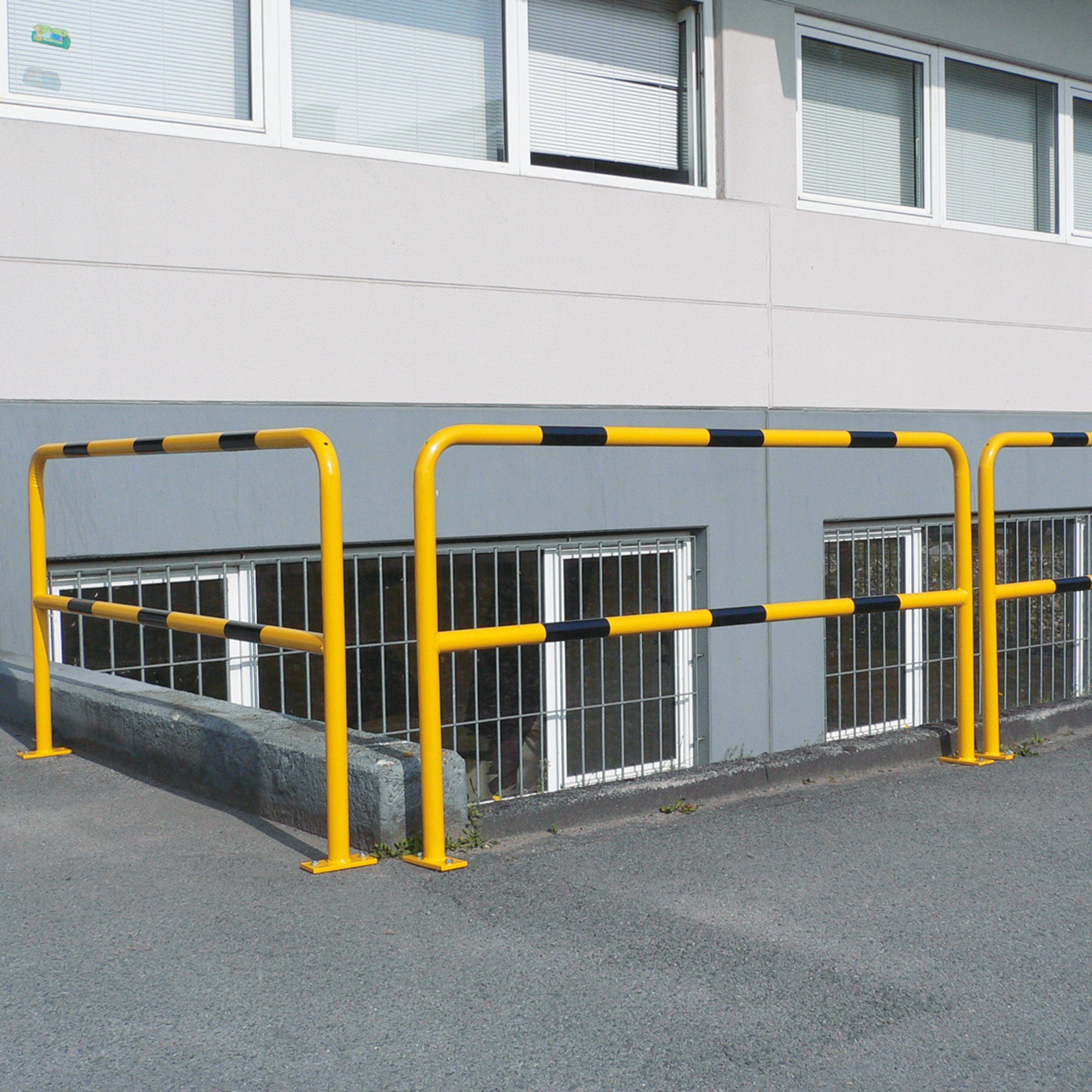
A hoop barrier is more than just a piece of bent steel – it is a silent guardian for your property, your staff and your visitors. Its primary job is to act as a robust, reliable protective barrier, designed to absorb and deflect the force of a vehicle and thereby prevent collisions with people, buildings and sensitive equipment. It is a simple but extremely effective safety solution that comes in several variants, from heavy-duty impact protection to more elegant safety railings.
What Is a Hoop Barrier and Why Is It Such a Critical Safety Investment?
Picture a truck backing up toward a warehouse wall, a forklift navigating a tight space or cars parking close to a playground. In these situations, a properly installed hoop barrier is the difference between a minor dent and a potentially catastrophic accident. Quite simply, the barrier creates a clear physical separation between vehicles and whatever needs protecting. Choosing the right model, such as heavy-duty steel impact protection, is crucial to managing the specific risk.
This type of impact protection is a fundamental part of a systematic approach to safety. By clearly defining zones and protecting critical points, you can prevent accidents long before they happen. It is all about creating a predictable, safe environment where the risk of impact damage is minimized.
Typical Risk Areas Where a Hoop Barrier Makes All the Difference
The applications are many and varied, but some locations are particularly exposed and clearly need solid protection. A hoop barrier is often the very best solution for securing these zones.
- Warehouses and logistics centers: Heavy-duty impact protection shields warehouse doors, racking, machinery and staff from forklifts and other internal vehicles.
- Parking lots and parking garages: Prevents cars from rolling into building walls, walkways, EV chargers or other vehicles. Our hoop barriers for parking are designed for exactly this.
- Public spaces: Protects pedestrians at crosswalks, separates bike lanes from car traffic and secures playgrounds and schoolyards.
- Industrial areas: Defines driving lanes and protects technical equipment, gas lines and electrical cabinets from heavy vehicles.
A strategically placed hoop barrier is not a cost but an investment in safety and operational reliability. It protects not only physical assets but, most importantly, human lives.
Proven Effect in Swedish Traffic Environments
Hoop barriers have become an indispensable safety component in everything from parking garages to busy stretches of road. Data from the Swedish Transport Administration in Dalarna shows how roads near built-up areas with up to 3,600 vehicles per day, 240 of them heavy vehicles, create major collision risks. In projects where pedestrian and bike paths have been separated with robust protection, a direct and measurable effect on road safety has been observed.
Historically, the number of accidents linked to inadequate railings has dropped by up to 30 percent on renovated stretches. This clearly shows the difference the right protective equipment makes. For us at Nordguard and our customers, it means that CE-marked hoop barriers are a proven solution that works in the real world. You can read more about the project and its results in the Swedish Transport Administration’s road plan for Gustafs.
Once you understand the risks, it also becomes clear why a hoop barrier is such a fundamental part of safety work. Want to learn more about different types of barriers? Read our guide on railings and hoops for effective protection.
Have you identified a risk area on your property? Not sure which type of hoop barrier best meets your needs? Contact us for expert guidance. Our team will help you find the perfect solution, whether it is a standard barrier or custom-made impact protection.
How to Choose the Right Material for Your Hoop Barrier
Choosing the material for a hoop barrier is one of those crucial decisions with long-term consequences. It is about more than just looks – the choice affects everything from the barrier’s strength and service life to how much maintenance it will need and what the total cost will be over time.
A material that is perfect for a salt-sprayed loading dock is rarely the best choice for a designer office entrance. To make a smart choice, you need to understand what sets the different options apart. The most common choices are hot-dip galvanized steel, stainless steel and powder-coated steel, each with its own strengths. Our range of steel impact protection and safety railings offers options for every environment.
Hot-Dip Galvanized Steel: The Robust Workhorse
When it comes to pure durability, hot-dip galvanized steel is the industry’s undisputed favorite. It is by far the most common solution for hoop barriers, and for good reason. The entire steel structure is dipped into a bath of molten zinc, creating an extremely durable, self-healing protection against rust.
If the surface gets scratched, the surrounding zinc “sacrifices” itself to protect the exposed steel. This allows the barrier to withstand harsh conditions with road salt and moisture year after year. Its somewhat raw, industrial look makes it the obvious choice for:
- Warehouses and logistics terminals
- Parking lots and parking garages
- Industrial areas and loading docks
Hot-dip galvanizing is the most cost-effective method for long-term corrosion protection. You get a virtually maintenance-free hoop barrier that can take a beating, making it a truly smart investment.
Stainless Steel: When Design Matters
In environments where appearance is as important as function, stainless steel is the obvious premium choice. With its sleek, brushed finish, it gives a modern, professional impression that elevates the entire surroundings.
But it is not just about aesthetics. Stainless steel is inherently highly resistant to rust and requires minimal maintenance to keep looking good. It is a perfect fit where the railings are part of the architecture, such as at entrances to offices, shopping centers or public buildings. Our stainless steel safety railings are an excellent example of this.
Powder-Coated Steel: For Color and Visibility
Do you want your hoop barriers to be highly visible or to match your company colors? Then powder coating is the answer. A colored powder is applied to the steel and then cured in an oven, producing an extremely hard-wearing, even finish that is far more durable than ordinary paint.
By choosing a color that stands out, such as classic safety yellow (RAL 1023), you maximize visibility and reduce the risk of collisions. But you can also use color to:
- Strengthen your brand: Use your company’s brand colors for a consistent look.
- Guide traffic: Mark different zones with different colors, for example for visitors and deliveries.
- Meet safety requirements: Some environments have specific requirements for warning colors.
Often, you get the best of both worlds: a hoop barrier is first hot-dip galvanized for maximum rust protection and then powder-coated in the color of your choice.
To make the choice easier, we have put together a quick comparison.
Comparison of Materials for Hoop Barriers
This table gives an overview of the most common materials and their key features, which can help you choose the right one for your environment.
| Material | Durability/Strength | Maintenance Needs | Corrosion Resistance | Aesthetics/Appearance | Typical Use |
|---|---|---|---|---|---|
| Hot-dip galvanized steel | Very high | Very low | Excellent | Raw, industrial | Industry, warehouses, parking, outdoor environments |
| Stainless steel | Very high | Very low | Excellent | Modern, upscale | Architectural settings, entrances, indoor |
| Powder-coated steel | High | Low | Good (depends on pretreatment) | Any color, even finish | Where color and visibility matter, brand identity |
As the table shows, it is a matter of weighing the pros and cons. There is no “best” material – only the best material for your specific needs.
To dig even deeper into how different materials compare, read our complete guide on choosing materials for impact protection.
Still finding it hard to choose? Get in touch with us at Nordguard. We will help you analyze your needs and find a solution that perfectly balances function, appearance and budget. Our team are experts in material selection and can guide you to the right impact protection or safety railing.
The Right Dimensions and Mounting – This Is Where Everything Is Decided
A hoop barrier can be made of the strongest steel in the world, but without the right dimensions and rock-solid mounting, it is practically useless. These two factors determine whether the protection actually works when it counts.
You could say that impact protection is a chain, and the installation is by far the most important link. If it fails, it does not matter how robust the hoop itself is. The force of a collision must be transferred into the ground in a controlled way – and that is exactly what proper mounting ensures.
Choosing the Right Height and Width
The size of a hoop barrier must always be matched to the specific threat it is meant to protect against. Stopping a car backing up in a parking lot is very different from protecting a building wall from a heavy truck.
- Height: This is absolutely critical. The barrier must hit the vehicle’s sturdiest parts, usually the chassis or bumper. A barrier that is too low can simply be driven over, while one that is too high risks missing the primary impact area on lower vehicles.
- Width: The width determines how large an area you protect. A narrower hoop barrier can be perfect for protecting a single EV charger, but shielding an entire door opening or walkway requires a wider model.
A good rule of thumb is that the height should match the average bumper height of the vehicles in the area. In mixed-traffic environments, where both cars and trucks operate, you need to go up in both height and dimensions to be safe.
Two Mounting Methods
Once you have decided on the size, it is time for the most important step: anchoring it to the ground. How this is done depends entirely on the surface, the risk level and how permanent the solution needs to be. Basically, there are two main methods.
1. Cast-in-place for maximum strength
This is by far the most robust method and the one we recommend in high-risk areas where the protection must withstand extreme forces. The barrier’s legs are simply set directly into the ground in concrete.
- Typical applications: Along busy roads, at loading docks and for protecting critical infrastructure.
- Advantages: Provides unbeatable strength and durability. Done correctly, the anchoring becomes stronger than the steel tube itself.
- Things to consider: Requires groundwork and is a permanent installation that is difficult to relocate.
2. Base plate mounting for flexibility
If you are installing on existing hard surfaces such as asphalt or concrete, a base plate is both a convenient and secure solution. The barrier’s legs are welded to a steel plate that is bolted to the surface.
- Typical applications: Parking garages, warehouse floors and other surfaces where you want to avoid digging.
- Advantages: Faster and easier to install. It is also easier to replace a damaged barrier without new groundwork.
- Things to consider: Strength depends entirely on the anchoring and the quality of the surface. The choice of expansion bolt or chemical anchor is critical.
Whichever method you choose, a properly prepared surface is essential. Sloppy anchoring or a weak surface means the entire protective function is lost in a crash. If you want to learn more about the principles behind this, read our overview of regulations and standards for impact protection.
Settling on the right dimensions and mounting method requires both knowledge and experience. Not sure what works best for your project? Get in touch with us at Nordguard, and we will help you with everything from analysis and calculations to the finished installation. Together, we will make sure you get a safe, durable solution that gets the job done.
Strategic Placement for Safety and Accessibility
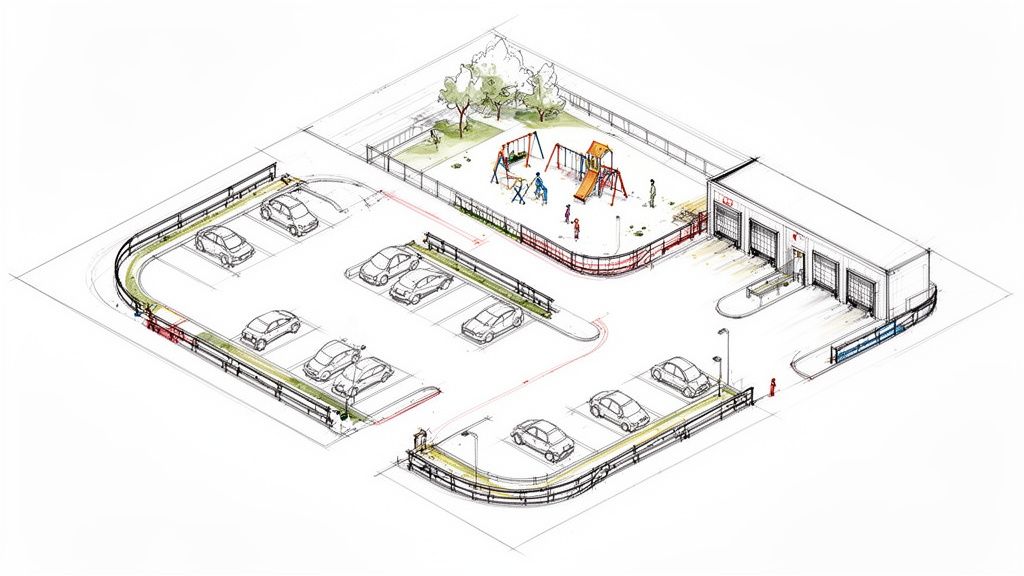
Where you place a hoop barrier is just as important as which barrier you choose. Poorly thought-out placement can, in the worst case, create new problems, such as blocking important emergency exits or preventing service vehicles from getting through. Planning the placement strategically is therefore essential for a safe, functional environment.
The key is to see how people and vehicles actually move through the area. Once you understand the natural flows, it becomes clear where the risks are. You can then use hoop barriers to proactively direct traffic, protect exposed corners and at the same time ensure everyone can get around unobstructed.
Identify and Protect Critical Zones
Before you install a single hoop barrier, take a step back and do a simple survey of the area. Where are the biggest risks? Where do different types of traffic cross? A hoop barrier should not be placed at random but should be a well-considered part of a larger safety plan.
Some typical critical zones to keep an eye on are:
- Building corners: These are extremely vulnerable to impacts, especially from vehicles making tight turns. Here, a hoop barrier acts as an effective bumper that protects the building from costly damage.
- Garage ramps: Protection along the ramp keeps vehicles from going over the edge and creates a safer passage for pedestrians.
- EV chargers and technical equipment: Expensive, sensitive equipment such as electrical cabinets or EV chargers are easy targets for an inattentive driver. A well-placed hoop barrier is cheap insurance.
- Walkways near roadways: Physically separating pedestrians from vehicle traffic is one of the most effective ways to prevent accidents, especially outside schools and stores or in parking lots.
Balance Safety with Accessibility
A common mistake is to accidentally create new obstacles in the pursuit of maximum safety. A hoop barrier must never block access for people with disabilities or hinder emergency vehicles.
According to Boverket’s Building Regulations (BBR), public spaces must be designed to be accessible and usable for everyone. This means you must leave enough room for wheelchairs and mobility scooters. A passage should have a clear width of at least 1.3 meters to allow two people to pass each other, and at least 0.9 meters on shorter stretches.
Considering accessibility from the start is not just a legal requirement – it is a basic prerequisite for an inclusive, well-functioning environment. Plan the placement so that everyone can move around freely and safely.
Concrete Examples of Smart Placement
Let’s look at how strategic placement works in practice in different environments:
- In the schoolyard: A hoop barrier is placed along the boundary with the parking lot. It creates a clear, physical barrier that keeps children from running straight out among the cars and stops vehicles from driving into the schoolyard.
- At the loading dock: Here, heavy-duty impact protection, often in the form of hoop barriers, is used to guide trucks into position and protect doors and walls from impact damage. The barrier acts as a visual and physical guide for the driver when backing up.
- In the parking garage: Barriers are placed in front of columns, walls and technical installations. They can also be used to clearly mark pedestrian routes and protect pedestrians from cars maneuvering in tight spaces.
Thinking through these flows and needs in advance is absolutely crucial for a successful installation. Proper planning saves both time and money and ensures that your hoop barrier performs its function in the best possible way.
Need help analyzing your area and developing a safety plan? Contact us at Nordguard. Our experts will help you design a tailored, functional solution that meets all safety and accessibility requirements.
How to Maintain Your Hoop Barriers for a Long Service Life
A hoop barrier is an investment in safety that should last a long time. But just like your car or your house, it needs a little care to stay in good shape and do its job year after year. With a few simple tips, you can significantly extend its service life and make sure the protection is always one hundred percent.
Ignoring maintenance is a bit like never changing the oil in your car – sooner or later it leads to problems that are far more expensive to fix than that small service. A simple maintenance plan is therefore smart insurance for your investment. By staying one step ahead, you catch minor flaws before they grow into big, costly ones.
Regular Inspection – the Foundation of All Maintenance
The most important, and easiest, thing is to give your hoop barriers a quick visual check at regular intervals. How often you need to do this depends entirely on the environment. A barrier inside a quiet warehouse obviously needs less attention than one at a busy loading dock where salt and exhaust fumes are a daily reality. A good rule of thumb is to do a thorough check once a quarter.
When you inspect, focus on these points:
- Is it secure? Give the barriers a shake. Do they feel solid and stable? If they are mounted with base plates, make sure all bolts are properly tightened. For cast-in-place barriers, check that the concrete around the foundation is intact and free of cracks.
- Has it taken a hit? Look for dents, deep scratches or other signs of impact. Major damage may look harmless, but it can have weakened the entire structure and reduces the barrier’s protective capacity.
- What condition is the surface in? Examine the coating carefully, especially at welds and mounting points where rust tends to take hold first. On powder-coated surfaces, watch for flaking paint. It is an open door for moisture to get in.
Fixing a small rust spot is easy – a little sanding and touch-up paint solves the problem. Waiting until the rust has really taken hold can, in the worst case, compromise the load-bearing capacity of the entire barrier. Then it will do no good when an accident actually happens.
Cleaning and Care of Different Materials
How best to care for your hoop barrier depends entirely on its material and finish. The right method not only keeps the barriers looking good but also protects them from wear and weather.
Hot-dip galvanized steel: This surface is extremely durable and virtually maintenance-free. Dirt, dust and road salt are easily rinsed off with plain water. Avoid harsh chemicals, as they can react with the zinc surface and cause staining.
Powder-coated steel: A coated surface looks great but is also more sensitive to scratches. Use a mild detergent and a soft brush or sponge. If you spot small scratches or stone chips, touch them up as soon as possible. This prevents moisture from creeping under the coating and starting a rusting process that is hard to stop.
Stainless steel: Despite its name, even stainless steel can develop surface rust, especially in harsh environments with lots of salt or air pollution. Regular cleaning with water and a mild detergent is the best way to keep the surface clean and resistant.
By following these simple tips, you ensure that your hoop barriers retain both their function and their appearance for many years to come.
Does maintenance feel like one more thing on your to-do list? We at Nordguard can help. We offer service agreements where we make sure your protective barriers are always in top condition. Contact us today and let’s talk about a maintenance plan that suits you and protects your investment.
Frequently Asked Questions About Hoop Barriers
When you are investing in safety products such as a hoop barrier, it is completely natural for questions to come up. To make things easier for you, we have gathered and answered some of the questions we hear most often from our customers. The goal is to give you quick, straightforward answers that help you make the right decision.
Choosing the right product and knowing the rules are essential for creating a safe, functional environment. Many people wonder about everything from materials and dimensions for a specific location to more formal matters such as building permits and markings. Let’s clear things up.
Which hoop barrier is best for a parking lot?
For a typical parking lot, where the purpose is to stop cars from rolling onto the wrong area, a hoop barrier in hot-dip galvanized or powder-coated steel is a perfect choice. We often recommend a height of about 800–900 mm. This is an effective height that hits most cars’ bumpers and stops them from going any further.
A smart option to really maximize safety is a yellow powder coating (RAL 1023). The bold color makes the barrier extremely visible, reducing the risk of accidents and collisions, especially in the dark or in bad weather. When it comes to the installation itself, base plate mounting is usually the easiest and most practical method on existing surfaces such as asphalt or concrete.
Do I need a building permit to install a hoop barrier?
This is a common and very important question. The answer is that it depends entirely on where the barriers will be installed.
- On private property: If you are installing within a private area – such as an industrial site, a company parking lot or the courtyard of a housing cooperative – in the vast majority of cases no building permit is required.
- On public land: If, however, the barriers are to be placed on public land, for example along a municipal street, or if they noticeably affect the streetscape, a permit from the municipality may be required.
Our strongest recommendation is to always make a quick call to your local building committee. It is a simple step that ensures you follow all the rules and avoid unnecessary hassle later on.
What does CE marking guarantee?
CE marking is your best guarantee that a hoop barrier meets the EU’s strict safety and performance requirements under the EN 1090 standard. It is much more than just a sticker – it is proof that the product has been inspected and quality-assured from start to finish.
Specifically, the marking means that:
- The material is traceable: You can rest assured that the steel meets the promised grade.
- Manufacturing is controlled: Everything from welding to finishing follows carefully established procedures.
- The product has tested strength: The barrier withstands the load and has the strength it is specified for.
When you choose a CE-marked hoop barrier from Nordguard, you are investing in a product that has been tested and verified. A product you can rely on when it really matters.
Do you have other questions, or do you need help choosing the right hoop barrier for your project? Our experts are ready to help you. Contact us today for personalized advice and a custom quote.
How We Work at Nordguard – From Idea to Finished Installation
Securing an environment with hoop barriers should feel safe and simple, from the first idea until everything is in place. That is exactly how we see it. At Nordguard, we are not just a product supplier – we are a partner that takes responsibility for the entire journey. We make sure you get a solution that works for your particular operation.
The process is easy to understand. Since no two projects are alike, we know the details are crucial. That is why we are with you every step of the way, making sure the end result is exactly what you want: strong, durable and correctly installed.
Step 1: We Start by Understanding Your Needs
Everything begins with a conversation where we listen to your situation. Together, we carry out a simple but thorough analysis to pinpoint exactly what you want to achieve and what risks exist in your environment.
- What vehicles operate in the area – forklifts, trucks or cars?
- What is the barrier’s primary purpose? Protecting a building wall, guiding traffic or separating vehicles and pedestrians?
- Does appearance matter? Should it blend in or stand out?
By asking the right questions from the start, we make sure the solution we propose really is the best one for you. This first step costs nothing and is the key to a successful project.
Step 2: Planning and Custom Solutions
With a clear picture of your needs, we develop a concrete plan. Here we help with everything from choosing the right material and dimensions to deciding on the smartest mounting method for your particular surface. Of course, we take legal requirements and accessibility into account.
Many of our hoop barriers can be customized. Perhaps you need a specific length, a color that matches your corporate identity or a special mounting solution? No problem, we will take care of it. The goal is a product that feels like a natural part of your environment.
Step 3: Manufacturing and Delivery
Once the plan is finalized, we start production of your CE-marked hoop barriers. Our efficient production chain and direct deliveries from the manufacturer give you several advantages. We can maintain short lead times and cut out unnecessary middlemen, which is both cost-effective and better for the environment.
Step 4: Installation and Follow-Up
Once the barriers have arrived, we make sure the installation is done correctly, whether you install them yourselves or use our recommended installers. But our job doesn’t end there. We always follow up on the project to make sure you are completely satisfied. We are still here for service and spare parts to ensure your investment lasts for many years to come.
Choosing Nordguard means you get a partner who is with you all the way and makes it easy to create a safer environment. Ready to get started? Get in touch with us for a free consultation and a quote tailored to your project.
Ready to take the next step?
We help you develop solutions tailored to your needs. At Nordguard, we strive to make the ordering process as smooth as possible. By offering support and guidance throughout the entire purchasing experience, we make sure you feel confident and satisfied with your choice of protection products.+46 10 153 90 50
[email protected]