
 15 cm Stencil Set for Letters and Numbers - Durable Plastic - No Mounting
 Column Protectors: A Complete Guide to Warehouse and Industrial Safety
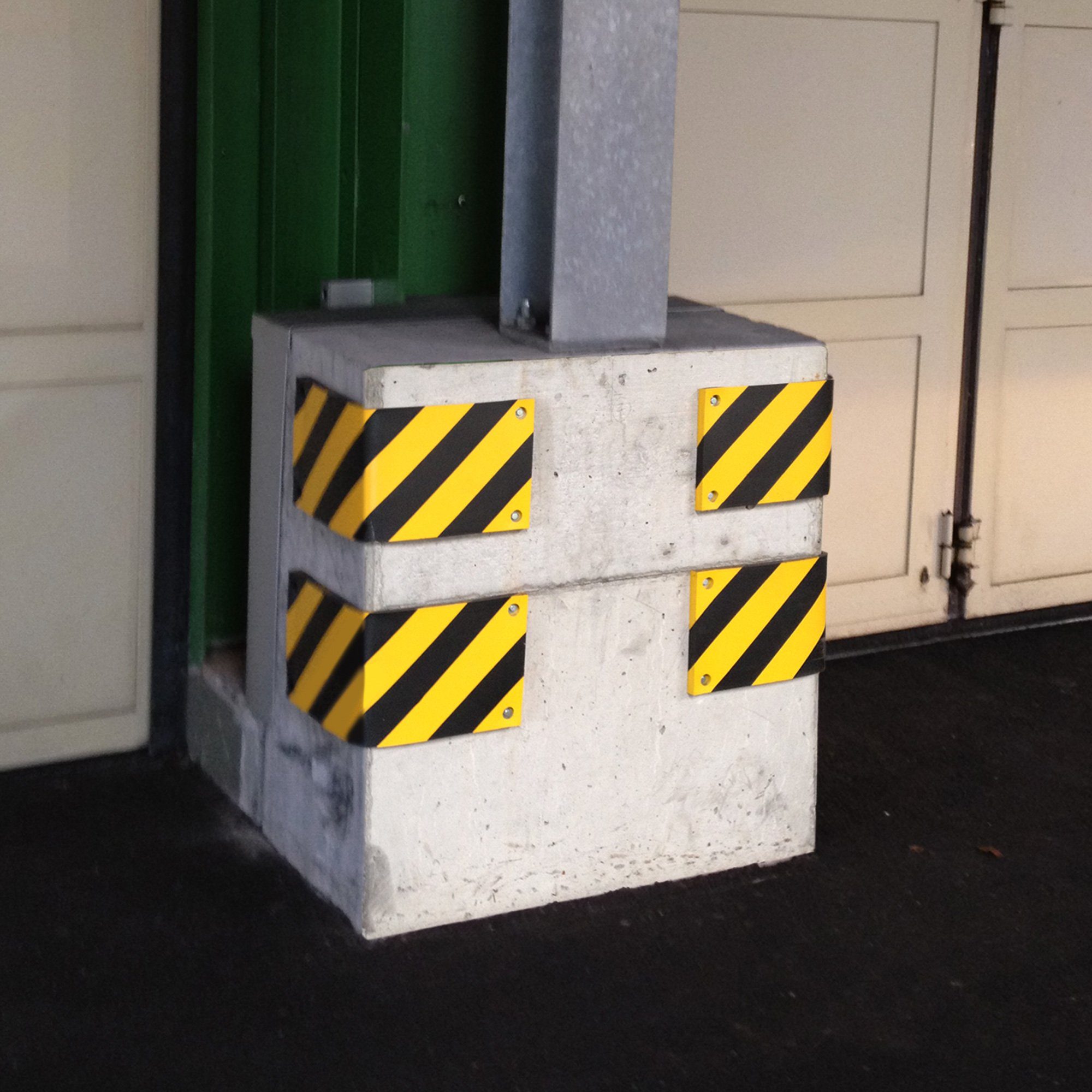
A column protector is essentially a custom-fit barrier that you install around load-bearing columns and posts. The purpose is simple but vital: to protect them from impacts by forklifts and other vehicles. Think of it as a shock absorber that captures and distributes the force of a collision. That way, the column, the vehicle and, not least, the driver are all protected.
Why column protectors are a critical investment
Picture an unprotected column in your warehouse. It’s like a goalkeeper with no defense. Every forklift impact is a guaranteed goal – costly damage to the building, dangerous downtime and a potential workplace accident. A column protector is that crucial save that shields your most valuable assets.
In environments with heavy vehicle traffic, such as warehouses, logistics terminals and parking garages, the risk of a collision is always present. The consequences of a damaged load-bearing column can be catastrophic, ranging from costly repairs to, in the worst case, structural failure.
The hidden costs of an impact
A column that has been hit is so much more than just a dent. The real costs are often hidden and can quickly spiral out of control. As a warehouse manager, property owner or safety manager, it’s essential that you understand these risks.
- Production stoppages: A damaged column may require an entire area to be cordoned off for inspection and repair. This leads to immediate and costly downtime.
- Repair costs: Repairing or reinforcing a load-bearing structure is a complicated and expensive process. Specialized contractors are often required.
- Safety risks: A weakened column poses a direct danger to staff and can lead to serious accidents.
- Penalty fees: If protection is inadequate, it can result in penalty fees from the Swedish Work Environment Authority following an inspection or accident.
Statistically, forklift accidents in Sweden cause damage worth billions of Swedish kronor every year. According to the Swedish Work Environment Authority, approximately 3,000 workplace accidents involving forklifts occur annually, many of which lead to costly downtime. In regions with a strong logistics sector, the introduction of CE-marked column protectors has reduced damage by up to 40% at protected installations. You can read more about safety statistics and preventive measures in Axelent’s report.
Installing the right column protectors isn’t just an investment in the safety of your building. It’s an investment in your employees’ well-being and in the continued operation of your business. It’s a proactive measure that turns a potential disaster into a manageable incident.
Understanding the risks is the first step. As we explain in more detail in our guide, impact protection is a crucial investment in workplace safety. Not sure which solution best fits your specific conditions? Contact us directly and we’ll carry out an expert analysis of your needs and help you build a strong and lasting defense.
Comparing materials for column protectors
Choosing a material for a column protector is a bit like choosing tires for a car. The choice depends entirely on the environment it will be used in and the impacts it actually needs to withstand. The most common materials are steel, polymer (i.e. plastic) and concrete, and each has its own strengths and weaknesses.
A flexible polymer protector can be compared to a shock absorber. It’s perfect for warehouses and logistics centers with heavy forklift traffic, where minor, repeated impacts are part of everyday life. The protector absorbs the energy, springs back to its original shape and minimizes damage to both the protector and the vehicle.
A robust steel protector, on the other hand, is more like an impenetrable wall. It’s ideal for protecting critical, load-bearing columns from heavy vehicles, where a single collision can have devastating consequences. Steel provides maximum resistance and is the obvious choice when compromise is not an option.
Steel protectors – the robust defense
Steel is the traditional and most proven material for column protectors, and for good reason. Its enormous strength makes it extremely resistant to heavy impacts from vehicles such as forklifts and trucks. It’s simply the best choice for protecting vital columns in high-risk areas.
The advantages of steel are clear:
- Maximum impact resistance: Can withstand enormous forces without giving way.
- Durability: With the right finish, such as hot-dip galvanizing, it gets superior protection against rust and corrosion, even in harsh outdoor environments.
- Flexible design: Can be shaped and adapted to fit specific columns and corners.
The downside is that steel requires more maintenance if the surface gets scratched, as this can lead to rust. Damage to a steel protector is also permanent and often means the entire unit has to be replaced.
The idea is simple: to mitigate the risk of collision in order to protect the two most important assets – the column and the vehicle.
Polymer protectors – the flexible, maintenance-free alternative
Polymer-based column protectors, often made from materials such as polyethylene (PE), have become increasingly common. Their biggest advantage is flexibility. In a collision, the protector deforms, absorbs the energy and then returns to its original shape. This reduces damage to both the vehicle and the column.
A polymer protector is a “forgiving” solution. It not only protects the column but also minimizes repair costs for your forklift fleet, contributing to a lower total cost of ownership.
These protectors are also colored throughout, which means scratches and scuff marks are barely visible. They are fully resistant to rust and most chemicals, making them virtually maintenance-free. They are a perfect fit for high-traffic, lower-speed environments, such as warehouse aisles or production facilities.
Concrete protectors – the permanent, heavy-duty solution
Concrete offers a permanent and extremely durable solution, mainly for outdoor environments or facilities with really heavy traffic. Concrete blocks act as massive barriers that effectively stop even heavy vehicles.
As demands for safety and sustainability increase, concrete-based systems have become more and more important. By reusing surplus concrete – up to 45,000 tons per year – robust and circular protection solutions are created. For our customers in warehousing and logistics, this means column protectors that can handle extreme stress.
Below is a quick comparison of the materials to give you a better overview.
Comparing materials for column protectors
An overview comparing the most common materials based on impact resistance, maintenance needs and typical applications.
| Material | Impact resistance | Maintenance | Best suited for |
|---|---|---|---|
| Steel | Very high | Low, but damage requires attention (rust) | High-risk areas with heavy traffic, protection of critical columns |
| Polymer | High (flexible) | Very low (virtually maintenance-free) | Warehousing, logistics, production environments with frequent, light collisions |
| Concrete | Extremely high | Very low | Outdoors, facilities with very heavy traffic, permanent barriers |
Each material has its place, and the best choice depends entirely on your unique situation. To weigh the pros and cons in even more depth, read our guide on choosing between plastic and steel for impact protection.
Not sure whether steel, polymer or concrete is right for your operation? Contact us at Nordguard. We’ll help you analyze your risks and find the most cost-effective solution.
How to choose the right column protector for your environment
Buying column protectors without first analyzing your needs is a bit like buying tires for your car without knowing whether it’s summer or winter – chances are you’ll get it wrong. A protector that’s too weak only gives a false sense of security, while one that’s far too heavy-duty is money down the drain. To get it right, you need to understand the risks in your particular environment.
It really all comes down to asking the right questions. By systematically going through a few key factors, you can find a solution that not only has a good purchase price but also keeps costs down over time thanks to less maintenance and fewer damages.
Start with the vehicles – what’s moving around your facility?
The first and by far the most important step is to get a clear picture of the types of vehicles that actually operate in the area. A column protector built to handle a light bump from a car in a parking garage won’t do much good against a fully loaded counterbalance forklift.
Here are some questions to ask yourself:
- Which vehicles operate here? Is it mostly cars, vans, forklifts or even heavy trucks?
- How much do they weigh and how fast do they travel? A light forklift creeping along requires a completely different type of protection than a heavy vehicle moving at speed. The deciding factor is kinetic energy (energy = ½ × mass × velocity²).
- At what height would a collision occur? The protector must be positioned where the impact is most likely to hit – whether that’s a bumper, a fork tip or a truck chassis.
Once you know more about the vehicles, you can start narrowing down the required impact resistance. This lays the foundation for choosing the right material and design.
Look at the surroundings – where will the protector be installed?
The next step is to zoom out and look at the location itself. The conditions where the column protector will be mounted play a huge role in which material and type of anchoring are best suited.
Consider the environment part of the equation. A column protector that works perfectly indoors in a dry, clean warehouse can quickly fail if it’s placed outdoors without proper protection against the elements.
Here are the most important environmental factors to keep in mind:
- Indoor or outdoor? Outdoor environments place tough demands on rust protection and UV resistance. Hot-dip galvanized steel or specially treated polymers are often the way to go.
- Are chemicals or road salt present? In industries with corrosive substances, or in parking lots that are heavily salted in winter, you need materials that resist corrosion, such as stainless steel or HDPE polymer.
- What is the floor or ground like? The quality of the substrate (concrete, asphalt, etc.) determines which type of anchoring can be used to ensure a safe and durable installation.
The column’s shape and function are the final piece of the puzzle
Finally, you of course need to take the column itself into account. Its shape, size and purpose are key to determining which model of column protector is the smartest solution.
Is the column round, square or rectangular? There are model-specific protectors for most standard shapes that provide a tight and effective fit. For columns with a more unusual shape, or to protect exposed wall corners, modular systems may be a smarter choice.
Also consider the column’s function. A load-bearing concrete column in a logistics center is a critical part of the building’s skeleton and requires really robust protection, usually in steel. A column that mainly conceals pipes or cables may do fine with a lighter protector that primarily serves as a visual warning.
By carefully going through these three areas – vehicles, environment and column – you get a complete picture of your needs. This allows you to choose a column protector that provides maximum protection at a reasonable cost.
Not sure how to analyze your environment or which protector suits you best? Contact us at Nordguard for expert guidance. We’ll help you find a tailored, optimal solution for your facility.
To broaden your perspective, explore our range of impact protection and bollards below. These products offer complementary solutions for creating a comprehensive safety environment.


Mounting and maintenance of column protectors
A column protector that is incorrectly installed does no good. In the worst case, it creates a false sense of security, but when an accident actually happens, it won’t hold. For the protector to absorb and distribute the force of a collision as intended, a correct and solid installation is absolutely essential. It all starts with the foundation.
Before you even think about drilling, the substrate must be in good condition. Make sure the floor surface is clean, dry and completely free of cracks or other damage. An uneven surface prevents the protector’s base plate from making full contact with the floor, which weakens the entire structure. The risk is then high that the bolts will be torn out in an impact.
Choosing the right anchoring for your floor
How you anchor the protector depends entirely on the floor’s material and condition. For concrete floors, there are two main methods: expansion bolts and chemical anchors. Each is good at different things.
- Expansion bolt: This is the most common and fastest method for solid, good-quality concrete floors. The bolt expands in the drilled hole and creates a strong mechanical anchor. Simple and effective when conditions are right.
- Chemical anchor (chemical anchoring): This method is the solution when the concrete is porous, cracked or simply of lower quality. A two-component compound is injected into the drill hole before the threaded rod is inserted. As the compound cures, it creates an extremely strong chemical bond that distributes the load over a larger area without creating stress in the concrete.
Taking chances here can be costly. An expansion bolt in a porous floor won’t get a grip and can be pulled out by a light impact, making the entire protector useless. Sometimes special solutions are needed, for example in particularly tough conditions where in-ground mounting is preferred. For that purpose, there are dedicated solutions such as an adapter for column protectors with in-ground anchoring.
Regular maintenance for maximum service life
Once your column protector is in place, the job isn’t done – that’s when maintenance begins. A protector that is never inspected can lose its function without it being visible. By being proactive, you ensure that your investment lasts and protects your facility for a long time.
A damaged column protector is proof that an accident has happened. Ignoring the damage is like ignoring a warning signal – next time, it could be the column itself that takes the hit.
Regular inspections are essential. It’s not complicated, but it needs to be done systematically.
Column protector maintenance checklist:
- Check the anchoring: Make sure all bolts and nuts are secure. A loose bolt may mean the concrete has given way or that vibrations have shaken it loose.
- Inspect for damage: Look for dents, cracks and deep scratches. A deformed steel protector has lost some of its strength and should be replaced.
- Check the surface coating: Watch out for rust on steel protectors, especially at welds and damaged surfaces. Touch up immediately with anti-rust paint to stop corrosion. On polymer protectors, make sure the material hasn’t cracked or become brittle.
- Keep it clean: Wipe off dirt and oil. Not only does it look better, it also makes it much easier to spot damage at the next inspection.
By following these simple steps, you ensure that your column protectors are always ready to do their job. Need help with installation, maintenance or spare parts? Contact us at Nordguard and we’ll make sure your protectors are correctly installed and in top condition.
To further strengthen safety at your facility, explore our range of impact protection.
Understanding laws, requirements and CE marking
Navigating workplace safety regulations can feel like a tangled jungle of acronyms and clauses. But when it comes to column protectors and impact protection, there are some basic requirements you simply need to know. It’s not just about protecting a column – it’s about complying with the law and taking responsibility for your employees’ safety.
The most important thing to look for is CE marking. Many see it as just a logo, but it’s so much more. The marking is the manufacturer’s guarantee that the product actually meets the EU’s essential requirements for safety, health and the environment. For you as a buyer or project manager, it’s a seal of quality showing that the protector has been tested and approved for its purpose.
Choosing a product without CE marking is taking a gamble. You have no idea how it will perform in a collision, and if an accident happens, the responsibility can fall heavily on you as the employer.
The importance of industry standards
In addition to EU requirements, there are more specific industry standards that set even higher demands. For warehouse and logistics environments, SS-EN 15512 is one of the most important. The standard governs how pallet racking should be designed and used, but it also sets clear requirements for impact protection.
For example, the standard specifies that uprights along forklift aisles must be protected with impact protection that is at least 400 mm high and designed to withstand a certain impact force. If you choose a column protector that meets or exceeds SS-EN 15512, you know it will do its job when it counts. That’s peace of mind for both your employees and your business.
Investing in certified, standardized products isn’t a cost – it’s insurance. It protects your staff, your property and your business against unforeseen events and costly consequences.
The Swedish Work Environment Authority and your responsibility
The Swedish Work Environment Authority is clear in its regulations (AFS). "Use of Forklift Trucks" (AFS 2006:5) states clearly that workplaces must be designed so that the risk of collision accidents is minimized. In practice, this means that fixed objects, such as load-bearing columns, must be protected.
Should an accident occur and an inspection reveal that safety was inadequate, it can result in significant penalty fees. Installing the right column protectors is therefore not just about creating a safer workplace – it’s a way to protect your company financially.
That’s why it’s essential to choose a supplier that understands and follows these rules. At Nordguard, we sell only CE-marked products designed to meet the tough requirements of modern industrial and logistics environments.
Summary of key points:
- CE marking: Your basic guarantee that the product meets EU safety requirements. Skip anything else.
- SS-EN 15512: An important standard that sets specific requirements for impact protection for pallet racking.
- Swedish Work Environment Authority regulations: Legal requirements that place the responsibility on you as the employer to minimize collision risks.
Knowing this makes you a more confident and responsible buyer. You ensure that you invest in solutions that provide real protection and keep your business on the right side of the law.
Not sure which requirements apply to your environment? Contact us at Nordguard for expert guidance. We’ll help you navigate the regulations and choose the right certified products.
Explore our range of protective products that help you meet safety requirements.
Real-world examples of successful safety solutions
Theory and product sheets are one thing, but seeing how a column protector performs in real life gives you a completely different understanding. After all, investing in safety is about solving real, everyday problems that cost money, cause downtime and put staff at risk.
Here are two customer cases that clearly show how the right protection solution can make a huge difference. It’s about going from constant repairs and headaches to safety and efficiency.
Case 1: The logistics center that put a stop to costly damage
A fast-growing logistics center in central Sweden was struggling with a recurring and costly problem. In their busiest forklift aisles, the pallet racks were constantly being hit. Every impact meant not only expensive repairs but also dangerous downtime with entire aisles having to be closed off.
The operation was bleeding both time and money with every incident. The problem was simple: their existing, basic protectors just couldn’t handle the pressure from the intense traffic.
Our on-site analysis showed that they needed a more dynamic solution. We recommended and installed flexible polymer column protectors. These work almost like a shock absorber – they absorb the force of an impact and then spring back to their original shape, ready for the next hit.
The result? An immediate and dramatic reduction in damage. The new polymer protectors have virtually eliminated damage to the pallet racks, bringing repair costs close to zero and minimizing unplanned downtime. The investment paid for itself faster than expected.
Case 2: The housing cooperative that created a safer garage
A housing cooperative in a large city had a completely different, but equally frustrating, problem. Their parking garage was cramped and difficult to maneuver in, with several load-bearing concrete columns that always seemed to be in the way. The result was constant body damage to residents’ cars and unsightly scrape marks on the columns.
This not only caused frustration and costs for the residents but also a sense of insecurity. The cooperative needed a solution that would both protect the cars and make the columns much more visible.
Here we installed shock-absorbing, high-visibility column protectors in bright warning colors. The protectors are designed to be forgiving in a minor collision; they absorb the impact and protect both the car’s paint and the concrete column itself.
The clear color marking also made the columns much easier to spot, reducing the risk of misjudgment when parking. The effect was immediate:
- The number of reported body damage incidents dropped significantly.
- The columns were finally protected from further wear.
- Residents found the garage considerably safer and easier to navigate.
These two cases show how the right product in the right place creates tangible value. Whether it’s a high-traffic warehouse or a cramped parking garage, a well-planned column protector creates a safer and more cost-effective environment for everyone.
Do these problems sound familiar from your own operation or property? Contact us today for a free consultation. We’ll analyze your needs and develop a solution that protects your assets and creates peace of mind.
Frequently asked questions about column protectors
Here we’ve gathered some of the most common questions we get from our customers. The answers are straightforward and simple, so you can quickly get the information you need to choose the right protection for your facility.
Which column protector is best for outdoor use?
When it comes to outdoor environments, the choice of material is key. The protector must withstand everything from driving rain and snow to strong UV radiation. Hot-dip galvanized steel is often the obvious choice. The finish provides superior rust protection that ensures a long service life, even in our harsh Nordic climate.
There are also modern polymers (HDPE) designed to withstand the elements without cracking or fading. Which one you choose ultimately depends on the type of impacts the protector needs to withstand and the aesthetic requirements of the location.
How high should a column protector be?
The height of a column protector should always be adapted to the greatest risk. A good rule of thumb in a warehouse is that the protector should be high enough to catch both the forklift’s forks and its chassis. This usually means a height of somewhere between 400 mm and 1200 mm.
In a parking garage, where the risk instead comes from cars, such a tall protector is rarely needed. A lower one designed to meet the car’s bumper is often sufficient. The key is to do a quick analysis of the traffic to find a height that provides maximum protection.
Sound complicated? We’d be happy to help you analyze your environment and recommend a solution that’s both safe and cost-effective.
Can column protectors be mounted directly on asphalt?
Absolutely, that works just fine! But it requires the right type of anchoring. Asphalt is a much softer material than concrete, which means standard expansion bolts won’t get the grip needed for a safe installation.
For stable, durable mounting, longer bolts are used instead, together with chemical anchors or special asphalt anchors. It’s also wise to first assess the thickness and quality of the asphalt to make sure the installation will hold over time.
Have more questions or need help finding the right column protector for your specific needs? Get in touch with us at Nordguard and we’ll offer you a free consultation. Visit us at https://nordguard.eu.
Ready to take the next step?
We help you develop solutions tailored to your needs. At Nordguard, we strive to make the ordering process as smooth as possible. By offering support and guidance throughout the entire purchasing experience, we make sure you feel confident and satisfied with your choice of protection products.+46 10 153 90 50
[email protected]