
Bike Racks That Work in Practice
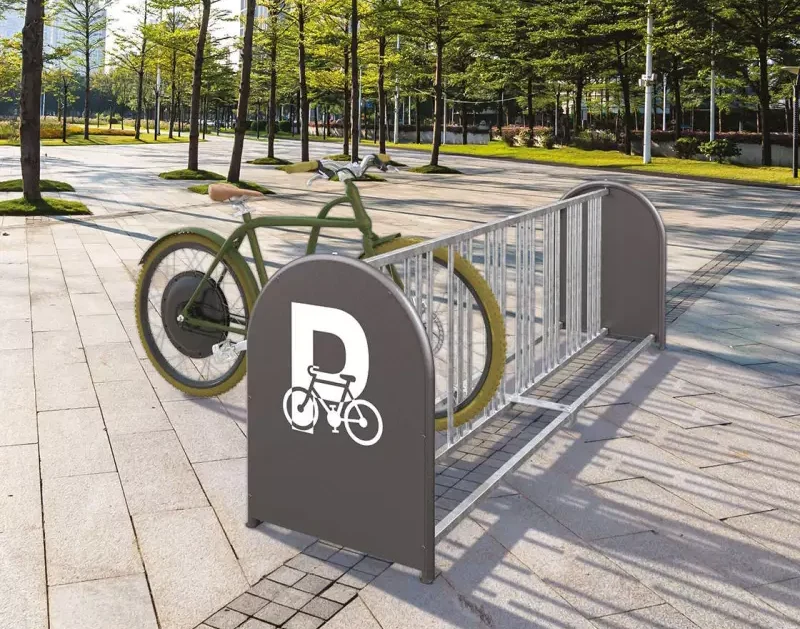
Cluttered courtyards, blocked entrances and bikes that disappear. Often the problem isn’t the number of bikes, but the lack of smart bike parking. A strategically chosen bike rack is so much more than a metal hoop – it’s an investment in security, order and the value of the entire property.
Why the right bike rack is crucial for a functional outdoor environment
A well-planned outdoor environment is about creating spaces that are both functional and inviting. But bikes dumped haphazardly against the facade, blocking emergency exits or taking up valuable space are a constant headache for housing cooperatives, property owners and municipalities. It doesn’t just create clutter and daily frustration – it’s a direct safety hazard.
The root of the problem is almost always the same: there are no proper bike racks that actually work in practice. Without a dedicated, secure place to leave their bike, people choose the easiest option, even if it’s completely wrong. The consequences aren’t long in coming.
More than just keeping things tidy
Investing in the right kind of bike rack solves several concrete problems at once and delivers clear, measurable benefits.
- Reduced risk of theft: A sturdy bike rack that lets you lock the frame securely is by far the best protection against theft.
- Greater security: Organized areas provide better visibility and reduce the risk of vandalism and unwanted activity.
- Freed-up space: When bikes are gathered in one designated place, space is freed up for other uses, such as playgrounds, seating areas or greenery.
- Increased property value: A well-maintained, functional outdoor environment makes the property more attractive and contributes directly to a higher value.
For those facing really big challenges with limited space or high security requirements, complete bike shelters can be the ultimate solution, protecting bikes from wind, weather and theft in a fully locked environment.
An investment that deters bike theft
Bike theft is a persistent problem that directly affects people’s willingness to use the bike as a means of transportation. Although the numbers have dropped from the peak of over 126,000 reports in 1993, between 63,000 and 77,000 bikes are still reported stolen every year. As bikes become more expensive, not least e-bikes, secure parking becomes increasingly important. It’s about reducing theft while encouraging more sustainable travel. Read more about the statistics in the report from the Swedish National Council for Crime Prevention.
A good bike rack doesn’t just solve a parking problem; it builds a culture of order, security and respect for shared spaces.
Turning bike chaos into a functional, appreciated asset takes more than just buying a product. It’s about understanding the real needs on site. Are you struggling with clutter, lack of space or theft? Contact us, and we’ll help you analyze your specific situation and find the perfect solution for your property or municipality.
How to choose the right type of bike rack for your needs
Choosing the right bike rack can feel like a jungle. Should you prioritize maximum security for expensive e-bikes? Squeeze as many bikes as possible into a cramped courtyard? Or find a solution that blends in nicely with the architecture?
Each model solves a specific problem. The key is to identify which problem is the biggest for you.
A common mistake is to focus solely on price. Instead, think of it as a long-term investment in security and function. A cheap rack that no one uses because it’s too cramped – or even worse, one that doesn’t protect against theft – quickly becomes an expensive and pointless expense.
Let’s break down the most common types so you get a clearer picture of what suits your situation.
Bike racks for maximum security
When security is the top priority – especially in public spaces or residential buildings with many valuable bikes – frame locking is absolutely essential. Bike thieves look for easy targets, and a rack where you can only lock the front wheel is an open invitation.
- Frame-locking hoops (A-racks): This is the classic and perhaps most robust solution. The simple design lets you lock the bike’s frame, its most valuable part, with a heavy-duty U-lock. They’re perfect for city centers, train stations and housing cooperatives that want to offer real security. In our range of standard bike racks, you’ll find several reliable models that solve this problem effectively.
- Bollards: A more design-conscious solution that combines function with aesthetics. Heavy-duty bollards work excellently as frame-locking points and can blend seamlessly into modern architecture without screaming “bike rack”.
This type of rack sends a clear signal: we take bike security seriously here.
Space-saving solutions for tight spaces
Space is often in short supply, especially in cities. Bike rooms, basement corridors and courtyards quickly become overcrowded. This calls for smart, space-efficient solutions that maximize capacity without compromising on function.
Doubling the number of bike spaces in the same area isn’t magic – it’s the result of smart planning and the right choice of product. A two-tier rack can be the difference between a chaotic bike room and a well-functioning one.
Two-tier racks are an excellent way to make use of vertical space. By parking bikes on two levels, you can effectively double the capacity on the same floor area. These systems are ideal for bike garages, office buildings and residential buildings where demand for bike parking is high.
Another smart solution is wall-mounted bike holders. They free up the floor space completely and are perfect for smaller storage rooms and garages.
Comparison of different types of bike racks
To make the choice a little easier, we’ve put together an overview comparing the most common models. The table gives you a quick picture of each type’s strengths and weaknesses, so you can see what suits you best.
Comparison of different types of bike racks
| Type of bike rack | Security level (1-5) | Space efficiency | Recommended environment | Advantages |
|---|---|---|---|---|
| Frame-locking hoop (A-rack) | 5 | Medium | City centers, housing cooperatives, schools | Very high security, robust construction |
| Two-tier rack | 4 | Very High | Bike garages, offices, stations | Doubles capacity, space-efficient |
| Wall-mounted holder | 3 | High | Garages, private storage rooms | Frees up floor space, good for storage |
| Bollards | 5 | Low | Architectural settings, public squares | High security with discreet design |
| Traditional front-wheel rack | 2 | High | Short-term parking, stores | Simple, inexpensive, high capacity |
As the table shows, there is no single bike rack that’s best at everything. It’s about finding the right balance between security, capacity and the environment where the rack will be placed.
Do you have a more complex project where several needs have to be balanced? Contact us for expert help, and we’ll help you analyze your situation and develop a tailored solution that works in practice.
Material choices that last – an investment for the future
The real value of a bike rack doesn’t show on delivery day. It shows after ten winters of snow, slush and road salt. The choice of material is by far the most important factor in deciding whether your investment will withstand the Nordic climate or turn into a rusty, unreliable parking spot. Choosing right from the start is the best guarantee of a low total cost over time.
A cheap solution with a poor finish may look good when new, but the problems come quickly. Once rust takes hold, it’s often the beginning of the end. Repairs and replacements become unavoidable, and that initial saving is quickly eaten up by maintenance and frustration.
Hot-dip galvanized steel – the obvious choice for our climate
In Swedish outdoor environments, there’s one material in a class of its own: hot-dip galvanized steel. The entire steel structure is dipped into a bath of molten zinc, creating a thick, extremely durable coating that penetrates every nook and cranny of the steel.
This provides unbeatable, self-healing corrosion protection. If the surface gets scratched, the zinc “sacrifices” itself to protect the steel underneath from corroding. A hot-dip galvanized bike rack is therefore a virtually maintenance-free solution that can handle decades of tough use without losing either function or strength.
Color and finish for the sake of design
Although hot-dip galvanizing offers the best protection, the silver-gray surface isn’t always what you’re after aesthetically. For property owners and companies who want their bike parking to blend in with a specific architecture or brand identity, there are excellent alternatives.
- Powder-coated steel: By powder coating a hot-dip galvanized bike rack, you get the best of both worlds. You get the superior corrosion protection of the zinc and a hard-wearing colored surface in exactly the RAL color you want. This makes it easy to match the racks to everything from facade colors to company logos.
- Stainless steel: In settings where design and an exclusive feel are the top priority, stainless steel is a spot-on choice. The material gives a modern, sleek impression, is completely maintenance-free and naturally resistant to rust. Perfect for entrances to office buildings or modern residential complexes.
The need for good, durable bike parking is nothing new. Back in the 1940s, when driving was limited by fuel rationing, Sweden experienced a bike boom with as many as 750,000 bikes manufactured in 1948. It shows how long the need for smart bike solutions has been with us. Read more about the history of cycling in Sweden from 1940 to 1990.
The details that make the difference
Apart from the finish, two design details directly affect a bike rack’s service life and security: wall thickness and weld quality.
A bike rack is never stronger than its weakest link. A poor weld or material that’s too thin can make even the best-designed rack vulnerable to both vandalism and wear.
Wall thickness, meaning the thickness of the steel in tubes or profiles, determines how well the rack resists bending and deformation. Thicker material simply takes more abuse and is harder to destroy. Likewise, the quality of the welds is absolutely crucial. Professionally made welds create a strong, durable joint, while sloppy welds can easily fail under load.
When you’re facing a procurement, don’t settle for just specifying the type of material. Set requirements for wall thickness and ask for documentation of weld quality. These are the details that ensure you’re investing in a solution that actually measures up. Unsure which technical requirements you should set? Contact us, and we’ll help you draw up a requirements specification that guarantees a safe, long-term purchase.
Plan placement and spacing for maximum function
Even the most robust and secure bike rack is completely useless if it’s in the wrong place. Bike parking that’s hard to find, too cramped or blocks an important passage simply won’t be used. Then you get exactly the chaos you wanted to avoid: bikes still leaning against the facade, blocking the entrance and causing general frustration.
Thoughtful placement is therefore at least as important as the product itself. It’s about understanding how people actually move around and making the easy choice the right choice. Good bike parking should feel obvious, safe and easy to use for everyone.
Center-to-center spacing – the key to hassle-free parking
One of the most common mistakes is placing bike racks too close together. The intention is often good – fitting as many bikes as possible into a limited area – but the result is the exact opposite. Handlebars and pedals get tangled, and it becomes nearly impossible to park or retrieve your bike without scratching both your own and your neighbor’s.
The deciding factor here is the center-to-center spacing (CC dimension), meaning the distance from the middle of one space to the middle of the next.
- Standard bikes: A CC dimension of at least 60–70 cm is recommended. This gives enough room to handle the bike without any trouble.
- Wider bikes: E-bikes, cargo bikes and bikes with child seats need considerably more room to maneuver. Plan for a CC dimension of 80–100 cm to avoid tangles.
A smart trick is to alternate the height of every other space, as with our space-saving bike racks. This lets you optimize the area without compromising on function.
Skimping on the distance between bike spaces is a classic false economy. Cramped parking leads to fewer spaces being used and more damage, which defeats the whole purpose of the investment.
Another detail that’s often overlooked is the maneuvering space behind the racks. There must be enough room to easily roll the bike in and out. Make sure you have at least 150–200 cm of clear space behind each row of bike racks.
Strategic placement for security and convenience
Where you choose to put the bike rack has an enormous impact on how often it’s used and how safe it feels. Try to think about the cyclist’s entire journey, from arrival to locked bike.
Below is a simple illustration showing the typical production process for a durable bike rack, from raw material to finished, weather-resistant product.
The process shows how the steel is reinforced with a protective zinc layer before it gets its final color – a method that guarantees maximum service life in our Nordic climate.
Use this checklist to find the optimal location:
- Close to the entrance: Place the bike rack as close to the main entrance as possible. Convenience is everything. If it’s easier to lean the bike against a wall, people will do it.
- Weather protection: If possible, place the racks under a roof. A simple roof protects against rain and snow, which both extends the life of the bikes and makes the parking more pleasant to use.
- Lighting and visibility: A dark, secluded spot is an invitation to thieves. Make sure the bike parking is well lit and visible to passersby or from nearby windows. This significantly increases the sense of security.
- Avoid obstructions: Check that the location doesn’t block walkways, emergency exits or ramps. Poorly placed bike parking can quickly go from being a solution to a safety hazard.
Planning placement and spacing is basically about thinking like a cyclist and removing every obstacle and source of frustration. Finding it hard to bring all these pieces together for your property or site? Contact us, and we’ll help you develop a tailored layout that maximizes both function and security.
A top-quality bike rack is only half the job. If it isn’t properly anchored to the ground, it creates a false sense of security and, at worst, a real safety hazard. A wobbly bike rack can tip over and damage both bikes and people, while a poorly anchored rack can easily be pried loose by a determined thief.Installation is therefore just as important as the product itself. Professionally executed anchoring ensures that the rack withstands daily wear and truly works as a secure place to park and lock your bike, year after year.
Two routes to a stable base
When it comes to anchoring a bike rack, there are essentially two methods, each with its own advantages depending on the conditions on site.
- Casting in place in a concrete foundation: This is the most permanent and theft-resistant solution. We dig holes where the legs of the bike rack are lowered in, then the holes are filled with concrete. Once the concrete has cured, the rack is rock solid. The method is perfect for new installations or locations where maximum security and durability are the top priority.
- Bolting to an existing surface: This method is more flexible and often quicker to carry out. The bike rack is fastened with expansion bolts or special anchors directly into an existing surface such as concrete or asphalt. It’s an excellent option when you want to upgrade an existing area without having to dig.
The choice between the methods depends entirely on the surface and the requirements. Casting in place provides unbeatable stability, while bolting is a smart, efficient solution for hard, level surfaces.
Avoid the most common installation mistakes
Incorrect installation can quickly undo the entire investment. Often it’s small, simple mistakes that have big consequences.
Ignoring the quality of the surface is like building a house on sand. No matter how robust the bike rack is, it will never be more stable than the surface it’s attached to.
Here are some common pitfalls to keep an eye on:
- The wrong anchor for the surface: Trying to use standard concrete bolts in porous asphalt is a surefire recipe for trouble. Asphalt requires specialized anchors that can expand and grip the softer material. Here, a composite anchor for installation in asphalt is a superior solution that guarantees a stable installation that lasts over time.
- Ignoring unevenness: A bike rack mounted on an uneven surface will wobble. This creates unnecessary stress on the anchoring, which over time can cause the bolts to loosen or, at worst, weaken the material.
- Insufficient tightening torque: Bolts that aren’t tightened enough will work loose. It’s essential to follow the manufacturer’s recommendations to ensure the rack is properly secured.
For simpler bolt mounting on a perfectly level concrete surface, a handy facility manager can often do the job. But as soon as it involves casting in place, installation in asphalt or more complex conditions, hiring a professional installer is a wise investment. It not only guarantees a safe result, but also ensures that the product warranties apply.
Unsure which method suits your project best, or need help with a professional installation? Contact us, and we’ll give you expert advice or a complete quote for the entire job.
Frequently asked questions about bike racks – from quantity to installation
When it’s time to invest in new bike racks, the same kinds of questions tend to come up. Whether you represent a housing cooperative or a property company, or you’re a contractor, there are some common concerns that keep coming back. Here we’ve gathered the most common questions and given straight, practical answers.
The idea is that you’ll quickly get the information you need to make the right decision.
How many bike spaces do we actually need?
An old rule of thumb says 1.5 to 2 bike spaces per apartment for a housing cooperative. But that’s just a starting point. The best method is always to find out the actual need.
Run a quick survey among the residents – it gives a clear picture of how many bikes there are today. Also make sure to plan with some margin for the future. And don’t forget to set aside dedicated spaces for special bikes such as cargo bikes and e-bikes, which often take up considerably more room.
Which bike rack is the most theft-resistant?
The most secure bike rack is one where you can lock the bike’s frame, not just the wheel. Heavy-duty frame-locking hoops, like our A-racks, or sturdy bollards are excellent choices that really deter thieves.
But remember one thing: placement is at least as important as the model itself. A certified, secure bike rack in a dark, secluded spot gives a false sense of security and quickly loses its purpose.
So always choose a location that is well lit, visible and has plenty of foot traffic. Natural surveillance is often the best complement to a physically strong rack.
Can we install the bike racks ourselves?
Absolutely, if it’s a matter of simpler models that are to be bolted onto a level, stable concrete floor. A handy facility manager can often handle that job without any problems. But as soon as it gets a bit more advanced, we strongly recommend bringing in professional help.
This applies especially to:
- Casting in place in a concrete foundation.
- Installation in asphalt or other tricky surfaces.
- Mounting on uneven surfaces that require adjustments.
Incorrect installation can compromise both the security and the service life of the rack, which can become costly in the long run. The fight against bike theft is always relevant – in 2021 alone, insurance companies paid out compensation for over 44,000 reported bike thefts worth SEK 227 million. Proper anchoring is a fundamental part of bringing those numbers down. If you want to know more, you can read about how municipalities work with secure bike parking in Sweden.
Need expertise to ensure a perfect, durable result? At Nordguard, we’re happy to help you with everything from advice and planning to complete installation of your bike rack. Visit https://nordguard.eu to see how we can create a safer, more functional outdoor environment for you.
Ready to take the next step?
We help you develop solutions tailored to your needs. At Nordguard, we strive to make the ordering process as smooth as possible. By offering support and guidance throughout the entire purchasing experience, we make sure you feel confident and satisfied with your choice of protection products.+46 10 153 90 50
[email protected]