
 15 cm Stencil Set for Letters and Numbers - Durable Plastic - No Mounting
 Industrial Mirrors That Prevent Accidents in Your Operations
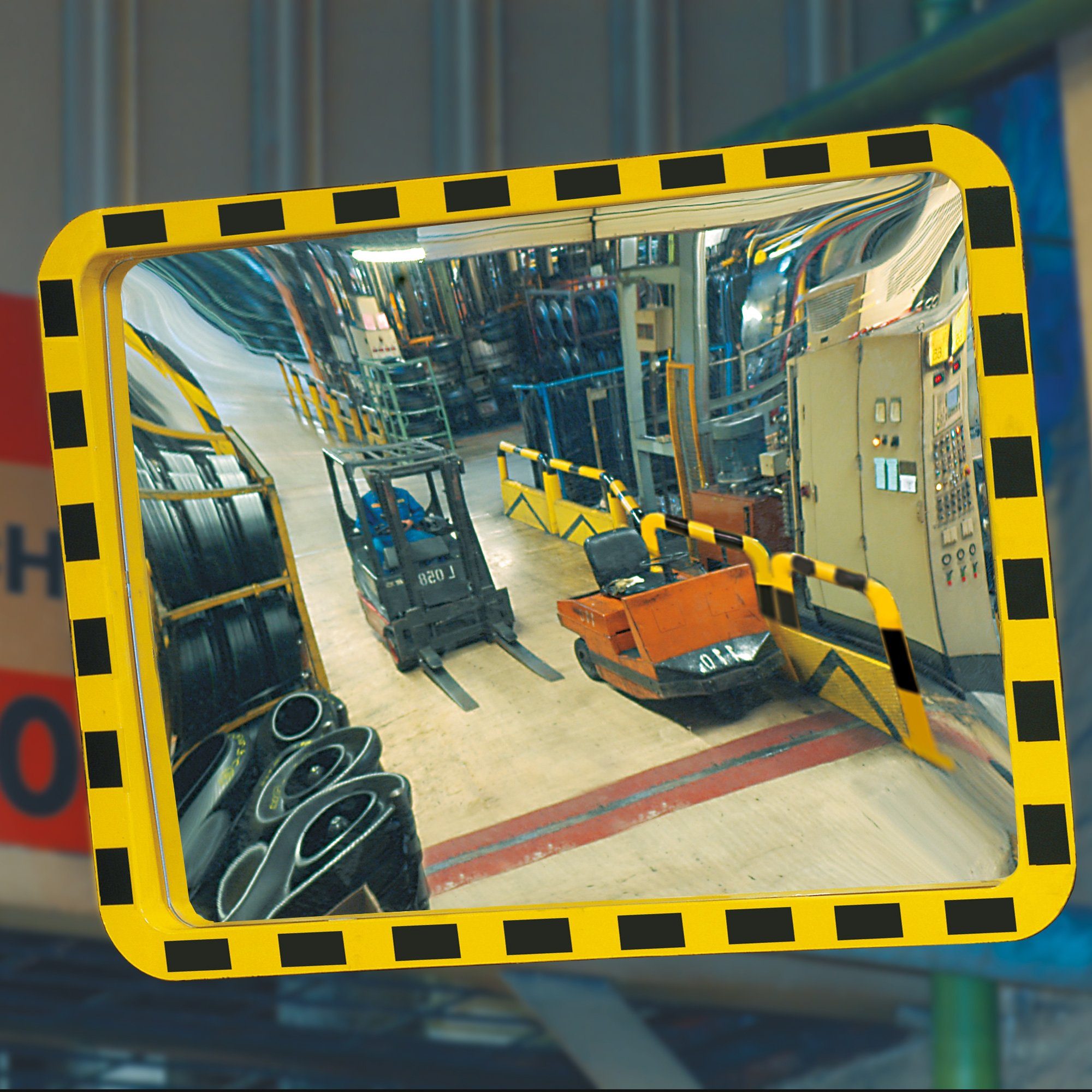
An industrial mirror is so much more than just a reflective surface. Think of it as a proactive safety tool – a silent warning system designed to eliminate blind spots and prevent accidents before they even have a chance to happen. In high-risk environments such as warehouses, industrial facilities and parking garages, it gives staff and drivers that extra overview that can make all the difference.
How an industrial mirror prevents costly accidents
Driving up to a blind corner is a bit like closing your eyes and hoping for the best. In dynamic environments such as warehouses, logistics terminals and production facilities, visibility is often limited, which creates unnecessarily dangerous situations. Forklifts turning around rack ends, trucks backing up to loading docks and staff moving between machines – all of these scenarios carry built-in risks.
A strategically placed industrial mirror works like an extra pair of eyes exactly where they are needed most. It provides a clear, wide view of areas that would otherwise be completely hidden, giving both drivers and pedestrians that vital extra second to react and avoid a collision. Our traffic and surveillance mirrors are designed to solve exactly these problems.
Identify and eliminate blind spots
The main job of a safety mirror is simple but brilliant: to turn a danger zone into a safe area. Blind spots are one of the most common causes of workplace accidents, and the consequences can be both serious and costly.
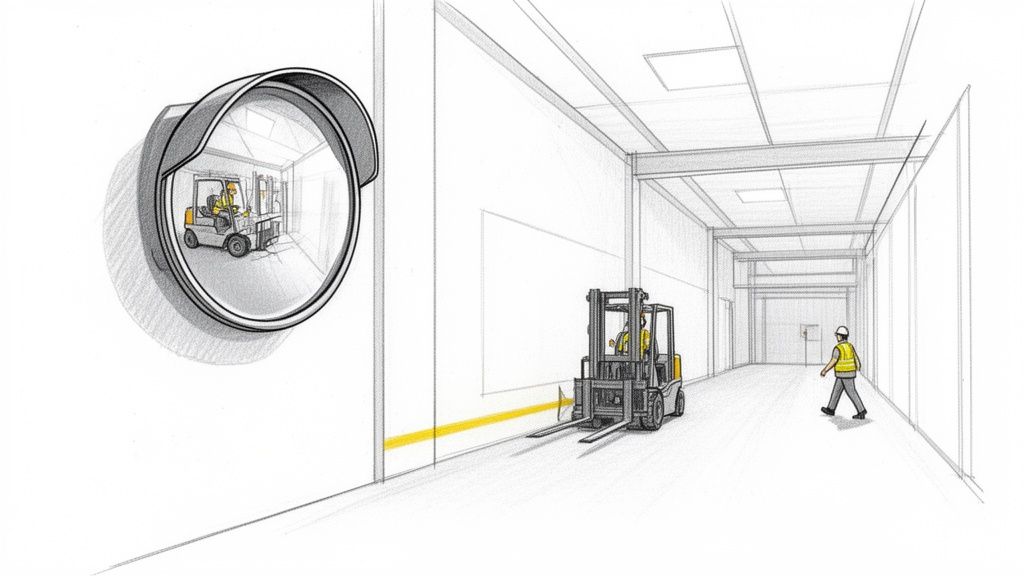
Imagine an intersection between two warehouse aisles. Without a mirror, a forklift operator has to slow down considerably, honk and carefully peek around the corner, which reduces efficiency. Or even worse, take a chance. With a convex mirror on the ceiling, the operator can instead see oncoming traffic from both directions and pass through smoothly and safely.
A well-placed industrial mirror doesn’t just increase safety. It also improves flow and productivity by reducing hesitation and unnecessary stops at hazardous passages.
This kind of situational awareness is crucial. It reduces the risk of:
- Vehicle collisions: Forklifts, trucks and other machinery can see each other in time.
- Accidents involving personal injury: Staff on foot become visible to vehicle operators at intersections and around corners.
- Damage to goods and equipment: Fewer collisions mean less damage to inventory, racking and machinery.
Investing in the right industrial mirror is a small cost compared to the enormous expenses an accident can lead to, both in terms of human suffering and financial losses. Have you identified any danger zones in your operations? Let us help you find the right solution. Contact us at Nordguard for a free needs assessment and we will put together a plan for a safer workplace. Our experts will help you identify the critical points where a mirror makes the biggest difference.
From Venetian luxury to Swedish industrial standard
Picture Sweden in the 1500s. A mirror was not something people took for granted, but a rare and unimaginably expensive luxury item. Its value could equal that of an entire farm. Today, an industrial mirror is instead a basic, inexpensive safety component you find everywhere – in warehouses, parking garages and on factory floors. That journey tells a rather fascinating story about innovation and Swedish industry.
The road from exclusive status symbol to indispensable workplace safety tool has been a long one. It reflects not only technological progress, but also how our needs as a society have changed. Once reserved for the nobility and the very wealthy, the mirror has become available to everyone and has been adapted to solve entirely new problems in an increasingly mechanized world.
The arrival of the mirror in Sweden
The first mirrors appeared in Sweden as early as the 1540s, imported from craft centers in Denmark, northern Germany and Holland. Old customs records show that they were small, costly and highly sought after. However, it was not until the 1700s that the mirror truly became a symbol of status and wealth. In 1734, a special luxury tax was even introduced on glass and mirrors, and a single mirror could cost as much as the value of 500 cows.
The staggering cost became the driving force behind starting domestic production. A key figure in this development was Burchardt Precht (1651–1738), often called the first great Swedish mirror maker. He imported the mirror glass itself but created magnificent Baroque-style frames that laid the foundation for Swedish craftsmanship. This early fascination with the mirror’s reflective properties was the first small step toward its future industrial use. Read more about the early history of the mirror in the Nordic region.
From craftsmanship to industrial necessity
The Industrial Revolution changed everything. As factories such as Pythagoras and LM Ericsson emerged in the late 1800s and early 1900s, entirely new and complex environments were created. Machines, trucks and a fast pace of work led to risks never seen before, such as blind corners and dangerous intersections.
This is where the mirror took on a whole new role. Thanks to machine-made glass, mirrors became both cheaper and easier to obtain, which opened the door for industries to start using them as safety devices. The once-exclusive luxury item suddenly became a practical tool for preventing accidents and creating better flow in noisy, cramped factory spaces.
The mirror’s journey is a perfect metaphor for industrial development: a luxury product for the few is transformed through innovation into a standard solution that protects the many.
Today, this development has reached its peak. A modern industrial mirror is a technical product, often made of impact-resistant acrylic or polycarbonate and CE-marked to meet rigorous safety requirements. This historical background makes it clear why a safety mirror from Nordguard is not just a product – it is part of a long tradition of Swedish engineering and safety thinking. The problems today’s mirrors solve have their roots in the challenges of the Industrial Revolution.
By understanding the mirror’s journey, we see that the need for visibility and safety is timeless. We help you apply this historical lesson to your modern workplace. Are you ready to identify your risk areas? Contact our experts for advice and we will show you how a modern mirror can protect your operations.
Choosing the right mirror for your unique environment
Choosing the right industrial mirror is absolutely crucial to achieving a safe workplace. It’s about much more than just putting up a reflective surface in a corner. For it to really work, you need to match the mirror’s features to the specific requirements and risks of your particular environment. A mirror that is perfect in an indoor warehouse can be completely wrong for an outdoor loading area or a food processing plant.
The choice comes down to different materials, sizes and shapes, and every detail matters. In the worst case, the wrong mirror can create a false sense of security, while the right choice actively helps prevent accidents and improves flow in your operations.
As you can see, the mirror has become a standard solution in industry. The next logical step is to get help from an expert like Nordguard to make sure you make the right choice today.
Choosing materials based on the environment
The material of the mirror surface itself is one of the most important pieces of the puzzle. It determines everything from how well the mirror withstands knocks and impacts to how it handles weather and chemicals. Understanding the differences is essential.
- Acrylic: This is the most common material for indoor use, for example in warehouses and stores. Acrylic is considerably more impact-resistant than ordinary glass and provides a really clear, sharp reflection. It is also lightweight, which makes mounting much easier.
- Polycarbonate: When conditions get really tough, both indoors and outdoors, polycarbonate is the superior choice. The material is virtually unbreakable and can withstand heavy impacts from forklifts or other equipment. Perfect for locations with a high risk of vandalism or collisions.
- Stainless steel: In environments with extremely strict hygiene requirements, such as the food industry or chemical plants, stainless steel is unbeatable. The material withstands strong cleaning agents and high temperatures and does not rust, without any loss of function.
To make the choice a little easier, we have put together a comparison table that gives you a quick overview of the most common materials.
Comparison of materials for industrial mirrors
A quick guide to the most common materials to help you choose the right mirror based on environment and requirements.
| Material | Impact resistance | Optimal environment | Key benefits |
|---|---|---|---|
| Acrylic | High | Indoor (warehouse, store) | Lightweight, clear image |
| Polycarbonate | Very high | Outdoor, high-risk areas | Virtually unbreakable |
| Stainless steel | Very high | Food, chemical industry | Hygienic, chemical-resistant |
This table provides a good foundation, but every situation is unique. For a more in-depth look at how to find the right model, read our guide on how to choose the right inspection mirror for your project.
Shape and size matter
Besides the material, the shape and size are absolutely crucial to the function. A convex (outward-curving) mirror is the standard in safety applications for a simple reason: it provides a much wider field of view than a flat mirror. The more convex the mirror, the larger the area it covers – but objects in the reflection also appear smaller and may seem farther away than they actually are.
Choosing the right convexity is a balancing act. The goal is to get maximum visibility of the danger zone without distorting distance perception so much that it creates new hazards.
The size of the mirror is mainly related to the viewing distance, that is, the distance between the viewer and the mirror itself. A simple rule of thumb to start from is:
- Measure the distance in meters from where you will usually be standing to the spot where the mirror will be mounted.
- Multiply that distance by 100.
- The result gives you an approximate recommended mirror diameter in centimeters. For example, a distance of 6 meters requires a mirror approximately 60 cm in diameter.
Don’t forget the CE marking either. It is especially important for mirrors used in public environments or where there is heavy traffic. The marking guarantees that the product meets the EU’s essential requirements for safety, health and the environment.
Not sure which material, size or shape is best for you? No problem. Contact us at Nordguard for personalized advice. We will help you analyze your needs and make sure you get a solution that is both perfectly tailored and safe.
Practical applications that increase safety
A well-placed industrial mirror is much more than just a safety component; it is an active lifesaver in environments where the margins are small. It does the most good where the risks are highest – places where people and machines constantly cross paths, often with obstructed visibility.
Let’s take a closer look at some of the most common scenarios where a mirror turns a danger zone into a safe passage. By understanding the specific problems in each environment, it quickly becomes clear how a simple mirror can offer a solution that is both effective and cost-efficient.
Warehouses and logistics centers with heavy forklift traffic
In a warehouse, every corner is a potential accident site. Forklifts move quickly between tall racks, and staff on foot are often fully focused on their tasks. A blind spot here can lead to really serious collisions.
- The problem: Blind intersections between warehouse aisles where forklifts and pedestrians meet without warning.
- The solution: A large convex industrial mirror mounted on the ceiling or on a post gives both drivers and pedestrians a 360-degree overview. This reduces the need to stop and honk at every corner, increasing both safety and efficiency.
Statistics from the Swedish Work Environment Authority show that correctly placed mirrors can reduce the number of incidents by as much as 35 percent.
Parking garages with narrow ramps and exits
Parking garages are notorious for their tight spaces, columns and sharp turns. Combine that with poor lighting and blind ramps, and it becomes difficult for motorists to see both other vehicles and pedestrians.
In a parking garage, safety is about giving drivers maximum visibility in minimal space. A traffic mirror is often the simplest and most effective measure for preventing fender benders and pedestrian accidents.
A well-placed industrial mirror at an exit ramp, around a corner or at a connection between levels gives drivers that extra overview they need to navigate safely. Want to learn more? See our guide on how to choose the right traffic mirror for increased safety.
Industrial sites and loading zones
On large industrial sites, heavy vehicles such as trucks and wheel loaders are constantly on the move. Ensuring good visibility at exits onto public roads, at loading docks and at internal intersections is absolutely crucial to avoiding serious accidents.
- The problem: Truck drivers have limited visibility when backing up to a loading dock or driving out through a gate, while staff and visitors may be moving in the same area.
- The solution: Large, weather-resistant outdoor mirrors, often with a red-and-white frame for extra visibility, give drivers a clear view of what is happening behind and around the vehicle.
Public environments for greater peace of mind
But an industrial mirror isn’t just for industry. The same principles apply in many public environments where safety and visibility are essential.
- Bicycle garages and storage rooms: A mirror can help prevent theft and create a greater sense of security by eliminating blind corners.
- Recycling centers: Here, private cars mix with heavy work vehicles. Mirrors at intersections and near containers reduce the risk of collisions.
- Residential areas: At garage exits or blind curves, a traffic mirror can prevent accidents involving children at play or cyclists.
Every environment has its own unique challenges, and a standard solution rarely goes all the way. Are you facing a specific safety problem where visibility is limited? Contact us at Nordguard. Our experts will help you analyze the situation and find a mirror that is perfectly suited to your specific needs.
Get the most out of your mirror – mounting and maintenance
An incorrectly mounted industrial mirror is ineffective at best. At worst, it creates a false sense of security that leads to the very accidents it was meant to prevent. For your investment to truly make a difference, both for safety and for your bottom line, it takes the right installation from the start and a little simple maintenance along the way.
Putting up a mirror is more than just screwing it into place. Height, angle, placement and choice of brackets – everything has to work together to provide a clear, sharp view of the hidden area. One small misstep can block the view, cause drivers to be blinded by the sun or leave the entire danger zone outside the reflection.
Step-by-step mounting
Mounting a mirror isn’t difficult, but it does require some thought. By following a few simple principles, you make sure it works as intended from day one and for many years to come.
- Find the right position: Stand where the driver or pedestrian will be. Where is the critical point you need to be able to see? That is where the mirror should provide visibility.
- Adjust height and angle: The mirror should be mounted at a height where it is easy to see but not in the way of vehicles. Then angle it carefully so the entire blind spot is covered, without distracting reflections from lights or sunlight.
- Choose the right bracket: Always use the right bracket for the mounting surface. A wall bracket works on flat surfaces, while post brackets are designed for round or square posts. Tighten everything securely so the mirror can stand up to wind and weather.
A classic mistake is mounting the mirror too low, where it easily gets hit, or being careless with the angle so that it only shows a fraction of what you need to see. Take the time to fine-tune everything before you tighten the screws for good.
Maintenance for clear, safe visibility
A dirty or damaged mirror quickly loses its function. Regular maintenance is essential for keeping a sharp reflection and making sure the mirror stays securely in place. Fortunately, it usually takes very little work.
A clean mirror is a safe mirror. A few minutes of inspection and cleaning a couple of times a year makes an enormous difference for safety and significantly extends the mirror’s service life.
Here is a simple checklist to follow:
- Cleaning: Wipe the mirror with a soft cloth, lukewarm water and a mild detergent. Acrylic mirrors scratch easily, so avoid harsh chemicals and abrasive materials. Rinse with clean water to avoid streaks.
- Check the brackets: Make sure all bolts and screws are securely tightened. Vibrations from traffic and wind can cause them to loosen over time.
- Inspect the surface: Check the mirror surface for cracks, deep scratches or other damage that could distort the image. A damaged mirror can give a false impression of distance and speed and should be replaced immediately.
Need help choosing the right bracket or have questions about mounting? Contact us at Nordguard today – we are happy to help you find the right parts for your specific mirror model.
Frequently asked questions about industrial mirrors
When you are thinking about investing in safety, it is only natural that questions come up. An industrial mirror is a fairly simple tool, but incredibly effective – and to get the maximum benefit, you need to choose the right one.
We have gathered some of the most common questions we come across to give you quick, clear answers. The goal is for you to feel confident in your decision and understand everything from field of view and regulations to how best to care for your mirror.
How far can I see in a convex mirror?
This is one of the most common and most important questions. The answer depends on two things: the size of the mirror (that is, its diameter) and how much it curves, what we call its convexity. A larger and more curved mirror simply captures more of the surroundings, which gives a wider field of view and lets you see farther.
A good rule of thumb is that the mirror’s diameter in centimeters corresponds to the approximate viewing distance in meters. A mirror that is 60 cm in diameter is therefore well suited for monitoring a distance of up to approximately 6 meters.
Keep in mind that a wider field of view makes everything in the mirror appear smaller and farther away. It’s a trade-off, and we are happy to help you find the perfect balance for your particular environment.
Does my traffic mirror have to be CE-marked?
It depends on where it will be installed. For an industrial mirror mounted in a public traffic environment, for example at an exit onto a municipal road, CE marking is often a requirement. The marking guarantees that the product meets the EU’s essential requirements for health, the environment and safety.
Even though it is not always a legal requirement for mirrors used only internally in a warehouse or on an industrial site, we always recommend choosing a CE-marked product. It is your assurance that the mirror is of high quality, made of the right material and safe to use.
How do I clean the mirror without scratching it?
Proper care is essential for the mirror to do its job year after year. To avoid scratches, especially on more delicate surfaces such as acrylic, a few simple tips apply:
- Use the right tools: A soft microfiber cloth is your best friend.
- Choose mild cleaning agents: Lukewarm water with a drop of mild, pH-neutral detergent (ordinary dish soap works fine) is all you need.
- Avoid harsh chemicals: Stay away from anything abrasive, ammonia-based glass cleaners or strong solvents. They can permanently damage the surface.
Always rinse with clean water afterward and wipe dry with a clean cloth to avoid spots.
Can you help me choose the right mirror?
Absolutely! That is exactly why we are here. Finding your way through the jungle of materials, sizes and brackets can feel overwhelming. Our experts have seen most things and know exactly what challenges exist in different environments.
We offer free advice where we go through your needs together. Based on that, we give you a crystal-clear recommendation on which industrial mirror gives you the most safety for your money. Ready to make your workplace safer? Contact us at Nordguard today and we will find the best solution for you.
Why Nordguard is your partner for a safer environment
Choosing an industrial mirror is so much more than just picking a product off a shelf. It is a long-term investment in safety – a solution that protects people, reduces costly property damage and keeps the flow in your operations running more smoothly. At Nordguard, we don’t just sell mirrors; we offer peace of mind and a partnership from start to finish.
It all starts with you and your reality. Instead of just reeling off a product list, we sit down together and carry out a thorough needs assessment. We help you map out risks, pinpoint critical zones with poor visibility and understand the unique challenges of your particular environment. Only when we have the full picture can we recommend a solution that actually works in practice.
Expertise that creates real value
Once the needs are clear, we put together tailored proposals from our carefully selected range. All our products are CE-marked, which is your guarantee that they meet rigorous quality and safety requirements. We guide you in choosing the right material, size and placement so you get the maximum effect from your investment.
Investing in safety means acting proactively. Think of us as your expert partner who helps you stay one step ahead of accidents, instead of just reacting once they have happened.
We believe in a simple, honest process. That means fast deliveries direct from the manufacturer to shorten lead times, transparent pricing with no hidden surprises and a strong focus on sustainability. With the option to carbon offset (CO₂) your delivery, we show that safety and environmental responsibility can absolutely go hand in hand.
In fact, the focus on sustainability and long service life has deep roots in Swedish industry. During the 1960s, a golden age for Swedish industry, glass production grew by approximately 5.0 percent per year (1955–1959). Modern glass manufacturing gave industrial mirrors a real boost. It is fascinating to see how mirrors from that era are still holding up – just as our modern, CE-marked solutions are built to last. Read more about the future prospects for Swedish industry at ifn.se.
A partner for the entire journey
Our commitment doesn’t end when the mirror is delivered. We see ourselves as your long-term partner and are there with advice, installation support and access to spare parts so your investment lasts as long as possible. By offering a complete solution, we become the obvious choice for a safer and more efficient workplace. Our goal is simple: to build a safer future, together with you.
Are you ready to take the next step toward a safer environment? Contact Nordguard for a free consultation and let our experts help you find the optimal safety solution for your operations. Visit https://nordguard.eu to start the conversation today.
Ready to take the next step?
We help you develop solutions tailored to your needs. At Nordguard, we strive to make the ordering process as smooth as possible. By offering support and guidance throughout the entire purchasing experience, we make sure you feel confident and satisfied with your choice of protection products.+46 10 153 90 50
[email protected]