
Anti-Slip for Outdoor Stairs – How to Choose the Right Protection
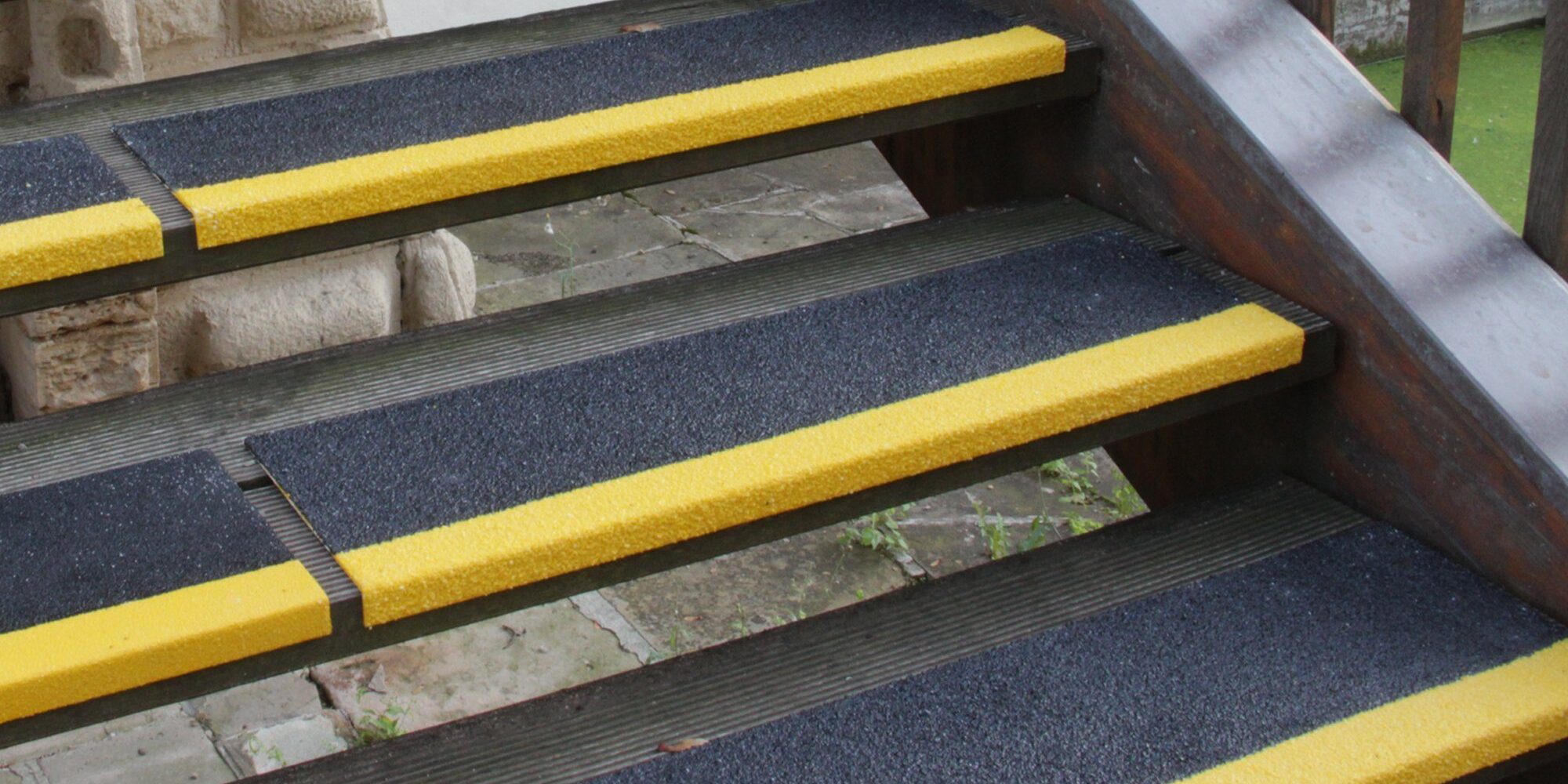
A truly effective anti-slip solution for outdoor stairs is often what determines whether a walkway is safe or simply an accident waiting to happen, especially during our long and unpredictable Swedish winters. This isn’t about finding quick, temporary fixes. It’s about installing permanent, durable protection that stands up to ice, snow and road salt without giving way.
Why your outdoor stairs are a hidden safety hazard
An ordinary staircase can turn into a serious hazard in just a few minutes. A frosty morning, sudden freezing rain or just a layer of wet leaves – the risks are many and the consequences can be severe. For property owners, municipalities and housing associations, the responsibility is significant, and turning a blind eye to the problem is simply not an option.
The problem is bigger and more widespread than many people realize. Every year, thousands of fall accidents occur in Sweden, and a large share of them happen on outdoor stairs. A single misstep can lead to anything from a mild sprain to complex fractures or concussions, causing personal suffering and costing the healthcare system enormous resources.
The accident risk in numbers
The statistics are clear. Roughly 25 percent of all slip-related injuries occur on or right next to outdoor stairs. That figure really shows how exposed this particular environment is. With around 70,000 fall accidents reported every year in Sweden, it’s clear that preventive measures are an absolute necessity, not just a recommendation.
The Swedish building regulations from Boverket (the National Board of Housing, Building and Planning) also set clear requirements for things like tread depth and contrast markings – measures proven to reduce accidents by up to 20 percent. You can read more about the specific stair safety regulations at Boverket.
Securing outdoor stairs is about so much more than just following regulations. It’s a fundamental part of creating a safe and accessible environment for everyone who moves in and around a property.
Long-term solutions are key
Sanding or salting are reactive solutions. They require constant work, quickly lose their effect and also create a lot of dirt and wear. A modern, sustainable solution is to invest in permanent anti-slip protection designed for outdoor stairs. Products such as angle profiles made of glass fiber reinforced plastic (GRP), like the one we offer at Nordguard, are an example of a superior solution.
These profiles have several crucial advantages:
- Extreme durability: They are built to withstand heavy foot traffic, snow shoveling with metal shovels and road salt without wearing down.
- Permanent grip: The surface keeps its coarse, slip-resistant texture year after year, regardless of the weather.
- Easy installation: They are mounted directly onto existing steps, whether made of concrete, wood or grating.
By choosing a permanent solution such as a robust angle profile, you get rid of a recurring headache once and for all. You not only dramatically reduce the risk of accidents, but also the ongoing maintenance. If you’re unsure which solution is best for your property, don’t hesitate to contact us for expert help.
Comparing anti-slip options for outdoor stairs
Choosing the right anti-slip solution for outdoor stairs is a critical decision. It’s about more than just solving a problem for the moment; it affects both safety and long-term maintenance costs. The market is full of options, from quick fixes to permanent installations, and it’s easy to get lost.
The choice often comes down to a cheap, temporary solution versus a more robust, permanent installation. A roll of anti-slip tape may seem tempting with its low purchase price. But in our Nordic climate, with constant shifts between moisture, ice and road salt, it doesn’t take long before the tape loses its grip. What was meant as protection can suddenly become a new tripping hazard when the edges start to curl up.
Temporary vs. permanent solutions
To make a smart choice, you need to look beyond the price tag and consider the total cost over time. What works not only today, but also five or ten years from now?
- Anti-slip tape: A short-term solution that is cheap to buy but requires frequent replacement. It wears quickly from foot traffic and weather, making it unsuitable for high-traffic areas.
- Anti-slip paint: Contains a sand-like texture that provides friction. However, the effect fades as the paint wears away, and it often needs repainting every year or two.
- Rubber mats: Provide good cushioning and some grip, but can become treacherously slippery when ice forms on top. They can also freeze in place, crack and shift, creating a new kind of accident risk.
The statistics on fall accidents speak for themselves. Stairs are one of the most common places where people get injured.
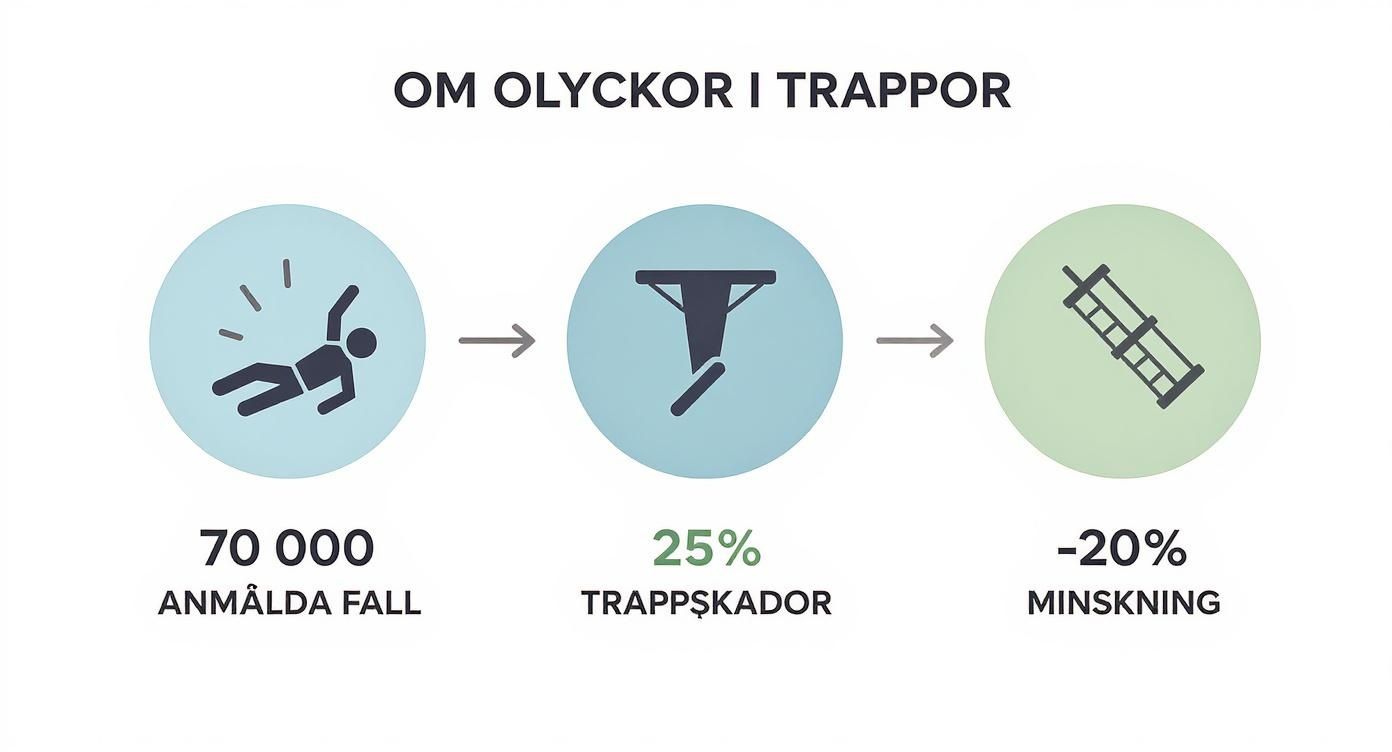
The numbers show that stairs are a critical risk zone. At the same time, they show that the right measures, such as effective anti-slip protection and contrast markings, actually deliver measurable results and reduce the number of accidents.
Here is a quick overview comparing the most common options based on what really matters in the long run: durability, performance in snow and ice, and total cost.
Comparison of anti-slip options for outdoor stairs
| Anti-slip type | Durability (1-5) | Winter performance (1-5) | Installation | Long-term cost |
|---|---|---|---|---|
| Anti-slip tape | 1 | 2 | Very easy | High (due to frequent replacement) |
| Anti-slip paint | 2 | 3 | Moderate | Medium (due to repainting) |
| Rubber mats | 3 | 2 | Easy | Medium (cracks/shifts) |
| Fiberglass angle profile | 5 | 5 | Moderate | Low (minimal maintenance) |
As the table shows, the cheapest solutions are rarely the most cost-effective over time, especially when you factor in the labor cost of replacement and repainting.
An investment in long-term safety
For property owners, housing associations and municipalities, the total cost of ownership is crucial. A solution that requires constant maintenance quickly becomes expensive. This is where angle profiles made of glass fiber reinforced plastic (GRP) stand out as by far the most durable and economical option in the long run.
A GRP profile is more than just anti-slip protection; it’s a permanent upgrade to the safety of your stairs. It protects the stair nosing itself from wear while providing uncompromising grip in all weather.
Unlike temporary solutions, a fiberglass angle profile is unaffected by road salt, UV radiation or mechanical wear from snow shovels. The silicon carbide surface is embedded in the material, guaranteeing secure grip year after year, completely maintenance-free.
If you’re looking for a reliable solution that simply works, this is the obvious choice. If you want to explore more options in floor marking and anti-slip, there’s a wide range to compare. Investing in a permanent solution is the smartest move to eliminate a recurring risk and protect the value of your property.
Do you have stairs that need to be secured before winter? Contact us and we’ll help you find the best and most durable solution for your property.
How to choose the right material for our Nordic climate
Choosing anti-slip protection for outdoor stairs here in Sweden is something entirely different from doing so in milder climates. Our seasons are brutal. They throw everything from driving rain and scorching summer sun to deep-frozen ice and aggressive road salt at the materials. A solution that looks good on paper can quickly fail when reality hits.
That makes the choice of material the single most important piece of the puzzle for a solution that actually works – not just the first winter, but year after year.
Many traditional materials simply have too hard a time here. Rubber can stiffen and crack in the cold. Metals that aren’t properly treated quickly start to rust from salt and moisture. Even if they provide decent grip at first, the surface wears down and loses its effect much sooner than expected. Something more robust is needed.
Why glass fiber reinforced plastic (GRP) is superior
This is where modern composite materials such as glass fiber reinforced plastic (GRP) have completely changed the game. GRP isn’t just a material; it’s a construction engineered to handle exactly the challenges our climate presents. Imagine a material with the strength of metal and the resilience of plastic, but without their respective weaknesses.
This unique composition offers several crucial advantages:
- Chemical resistant: GRP is virtually immune to road salt, oils and other chemicals that quickly break down other materials.
- Extremely durable: The surface, which usually has embedded silicon carbide grit, is almost as hard as diamond. It withstands heavy foot traffic and mechanical abrasion from snow shovels, year after year.
- Weather and UV resistant: The material neither fades in the sun nor becomes brittle in the cold, ensuring a long service life.
GRP is built to deliver maximum performance with minimal maintenance. It’s a solution you install once that then provides uncompromising safety for many years to come – no matter what the weather throws at it.
A historical shift toward safer materials
Safety on Swedish outdoor stairs has actually come a long way. Grooved steps were already in use in the 1920s, and building codes were tightened in the ’70s. Today’s advanced coatings and profiles can reduce the risk of slipping by up to 50 percent compared to an ordinary concrete staircase.
Products such as an anti-slip angle profile made of glass fiber reinforced plastic are the latest step in this development. They not only provide superior grip, but also protect the underlying stairs from wear, extending the service life of the entire structure. Choosing a material like GRP is an investment in a proven, future-proof solution.
Not sure which material best protects your stairs against weather, wind and wear? Contact us and we’ll help you analyze your needs and find a solution that ensures safety for many years to come.
Stair safety laws and regulations – what do you need to know?
Installing anti-slip protection on outdoor stairs is more than just a practical measure to prevent accidents. It’s a legal responsibility. As a property owner, housing association representative or contractor, you face clear requirements from both Boverket and the Swedish Work Environment Authority (Arbetsmiljöverket) that dictate how stairs must be designed to be safe for everyone.
Navigating the regulations can feel complicated, but at its core, it all comes down to two things: minimizing the risk of slipping and making the stairs easy to see, especially for people with visual impairments. Ignoring this can have costly consequences, both in the form of accidents and troublesome liability issues.
Boverket’s building regulations (BBR) in practice
Boverket’s building regulations, usually referred to as BBR, are the bible in this context. For outdoor stairs, there are two main points you need to keep track of.
- Slip resistance: The surface of the steps must provide enough friction to prevent slipping, even when wet or icy. This is often measured using an R value (slip resistance class), where R11 or higher is recommended for outdoor environments.
- Contrast marking: The first and last steps of the staircase, as well as any landings, must be marked with a color that clearly stands out from the rest of the stairs. This is essential for people with impaired vision to be able to walk safely.
The statistics speak for themselves. Falls on stairs are one of the most common causes of personal injury in Sweden and cost society an estimated SEK 1.5 billion every year. However, studies show that accidents decrease by about 15 percent when European slip resistance standards are followed. If you want to dig deeper, there are good tips on how to think about stairs early in the construction process.
How modern products meet legal requirements
Fortunately, meeting the requirements doesn’t have to be difficult. Today’s smart solutions are often designed to kill two birds with one stone. A perfect example is an anti-slip angle profile made of glass fiber reinforced plastic.
Such a profile not only provides an extremely high R value thanks to its coarse surface, but often also has an integrated yellow edge. This yellow nosing acts as a permanent, durable contrast marking, allowing you to meet both legal requirements with a single product.
By choosing a solution like this, you not only ensure your property complies with the law. You make a long-term investment in safety that reduces the risk of accidents, protects you from legal problems and creates a safer environment for everyone in the area.
Not sure whether your outdoor stairs meet today’s requirements? Get in touch with us. We’ll help you review the situation and find a product that both guarantees safety and lets you sleep well at night, knowing that all regulations are met.
Install your anti-slip protection like a pro
First-class anti-slip protection is only half the job – incorrect mounting can ruin the entire effect. For your outdoor stair anti-slip protection to provide maximum safety and last for many years, you need to do it right from the start. Fortunately, you can absolutely achieve a professional result yourself, as long as you follow a few simple ground rules.
The whole process really comes down to precision. Cutting corners on the prep work is by far the most common mistake and almost always causes the protection to come loose prematurely.
Step 1: Prepare the surface
Whether your stairs are made of concrete, wood or grating, a clean, dry and solid surface is essential. Any dirt, oil, loose paint or moisture will sabotage the adhesion of both adhesive and screws.
- Clean the surface: Use a wire brush to remove all loose dirt, moss and old paint residue. Then wash with a suitable cleaning agent and let the surface dry completely.
- Repair damage: Fill any cracks or unevenness in the concrete. Replace rotten or damaged boards on wooden stairs. Make sure the base is stable.
- Check for moisture: Never, ever install on a damp surface. Moisture is the adhesive’s worst enemy and can get trapped under the profile, which is guaranteed to cause problems down the road.
Step 2: Choose the right fastening method
For a permanent installation that truly stands up to our Nordic climate, a combination of adhesive and screws is almost always the best solution. The adhesive creates a tight, even seal against the surface, while the screws provide the mechanical strength needed to keep everything rock-solid.
Relying on adhesive alone outdoors is a gamble, especially with our large temperature swings. The screws ensure the profile stays in place even if the adhesive is affected by extreme cold or heat.
Make sure to use screws and anchors designed for your stairs’ material. A glass fiber reinforced plastic angle profile like those from Nordguard is easy to drill, making the entire mounting process much smoother.
Want to see other options? There’s a wide range of anti-slip tape and stair nosings to explore, but for permanent profiles, screw mounting is the way to go.
Step 3: Maintain for a long service life
Even the most robust anti-slip protection benefits from a little care. Regularly sweep away gravel and dirt that collect on the surface to maintain maximum friction. Make a habit of checking the fastenings once a year to ensure everything is secure.
Does it all feel overwhelming, or do you have a large, complex staircase to secure? Don’t hesitate to contact us. We’ll help you with everything from choosing the right product to providing detailed installation advice for your property.
Frequently asked questions about anti-slip for outdoor stairs
Here we’ve gathered the most common questions we receive about anti-slip protection for outdoor stairs. The answers are straightforward and simple, so you can feel confident in your choice.
What is the best anti-slip solution for outdoor wooden stairs?
For wooden stairs, we strongly recommend angle profiles made of glass fiber reinforced plastic (GRP). They do two jobs at once: they provide excellent grip and protect the wood’s vulnerable front edge from wear. The material is completely unaffected by moisture and is easily mounted with screws and adhesive directly on the step.
Tape is a temporary solution that rarely holds up. As soon as the wood gets wet and starts to move, the tape comes loose.
How long does fiberglass anti-slip protection last?
High-quality GRP anti-slip protection has an expected service life of over 15 years. This applies even in really tough environments with heavy foot traffic and constant exposure to road salt.
The material’s unique composition resists corrosion, UV light and extreme abrasion. That makes it a smart investment that pays for itself over time.
Is contrast marking required on my stairs?
Yes, in public environments it’s a requirement. According to Boverket’s building regulations (BBR), the first and last steps must have a contrast marking to assist people with impaired vision.
Many of our GRP profiles, such as our Glass Fiber Reinforced Plastic Angle Profile, have a built-in yellow nosing that solves this in a neat and durable way.
For private properties, it’s not a requirement, but it is strongly recommended. It increases safety for everyone who uses the stairs.
Can I install the anti-slip protection myself?
Absolutely. Most of our profiles are designed to be mounted with standard tools. The most important thing is to make sure the surface is clean, dry and solid. Just follow the installation instructions carefully and you’ll get a result that lasts.
Need help finding the right anti-slip protection for your outdoor stairs or want to discuss a larger project? At Nordguard, you’ll find durable solutions used by professionals. Contact us today and we’ll help you secure your property.
Ready to take the next step?
We help you develop solutions tailored to your needs. At Nordguard, we strive to make the ordering process as smooth as possible. By offering support and guidance throughout the entire purchasing experience, we make sure you feel confident and satisfied with your choice of protection products.+46 10 153 90 50
[email protected]